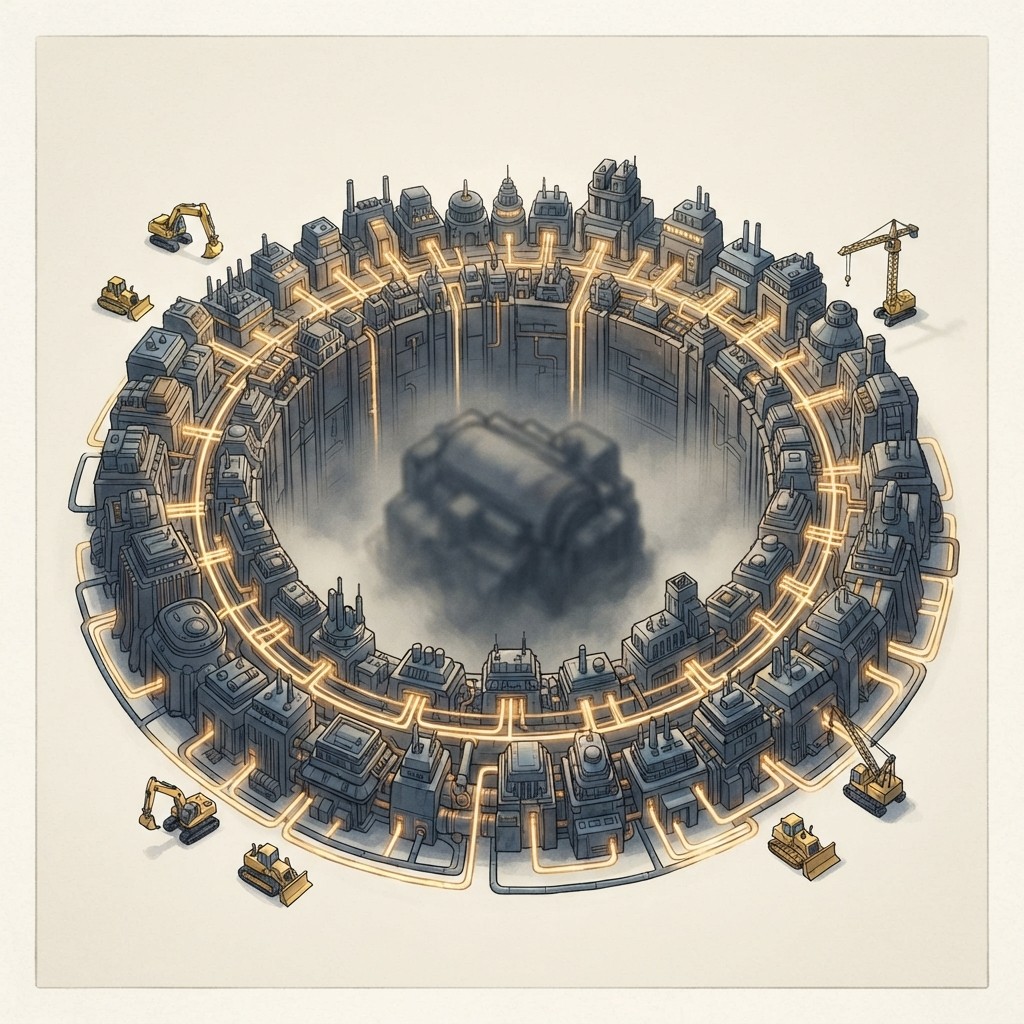
Pairs with the Moat Anatomy Canvas — a ready-to-use strategy tool, filled for Caterpillar. Included in the Moat Anatomy Casebook →
“What would it actually cost a challenger to take your customer?”
A bulldozer goes down at a mine 200 miles from the nearest city. Every hour it sits idle costs more than the operator wants to think about. Somewhere nearby — closer than seems possible — a Caterpillar dealer already has the part on a shelf, a technician in a truck, and a contract that promises to make the machine run again fast. The customer didn't buy yellow paint. They bought the certainty that someone would show up. That certainty is the product, and Caterpillar doesn't sell it. Roughly 156 independent companies do.2
The official story is that Caterpillar is a heavy-equipment manufacturer that happens to use dealers to sell its iron. That gets the moat exactly backwards. The machines are the easy part to copy — competitors build perfectly good excavators. What no one can copy is the network underneath them, and what makes that network priceless is no longer where the machines come from. It's where the parts come from, again and again, for decades after the sale.
Here is the thesis a smart friend could repeat: Caterpillar isn't a manufacturer with a great distribution channel. It's a century-old service network that happens to sell machines so it has something to service. The new-machine sale is the trailhead. The parts and the contracts are the road, and the road never ends.
The network is older than the company
Caterpillar Tractor Co. was formed on April 15, 1925, out of the merger of Holt Manufacturing and C.L. Best Tractor Co. — and the dealer network was wired in as a core partner from the very start.1 That's not a detail; it's the whole shape of the thing. The dealers were never a sales afterthought bolted on later. They were structural from day one. And some of them are older than the parent: there are Cat dealers that pre-date 1925, with founding dates running back into the early 1900s.2 The average Cat dealership today is just over 50 years old.2 You cannot acquire a 50-year-old relationship. You can only wait 50 years.
The independence is the genius, and it's counterintuitive. The dealers are separate businesses, many of them family-owned, two of them — Finning and Toromont, both Canadian — large enough to trade on public markets.8 Caterpillar doesn't carry their payroll, their real estate, or their parts inventory on its own balance sheet. It carries the relationship. The dealers put their own capital at risk to stock parts, staff branches, and serve exclusive territories, which means they have skin in keeping every machine in their region running — because that's how they get paid. Caterpillar gets a continent-spanning service army it doesn't have to fund.
The part on the shelf is worth more than the machine on the lot
Now the financial turn, and it's the one most people miss. In 2024 Caterpillar booked $64.8 billion in sales and revenues — down 3% from the year before, because new-machine demand moves in cycles that no one controls.4 But underneath that lumpy top line sits a number that barely flinched: a record $24 billion in services revenue — aftermarket parts and service-related work — flowing through the dealers.5 That figure didn't fall with the cycle. It grew from $14 billion in 2016 to $22 billion in 2023 to $24 billion in 2024, climbing from roughly a quarter of machinery revenue to about 39%.6 The machine sale is a bet on the economy. The parts that machine consumes for the next 20 years are an annuity.
| Selling the machine | Servicing the machine | |
|---|---|---|
| Revenue pattern | Cyclical — moves with construction and mining | Recurring — tied to the installed fleet |
| Who carries the relationship | Closed at the point of sale | The dealer, for the machine's whole life |
| What customers actually buy | An asset | Uptime |
| Easy for a rival to copy? | Yes — the iron is good across the industry | No — needs the local parts presence and decades of trust |
Why does the service revenue compound while machine sales lurch? Because every machine Caterpillar has ever sold is a future customer for the dealer who sold it. The installed fleet is a captive market that grows with every sale and shrinks only slowly with retirement. And the company has been deliberately deepening the lock: a new Services Commitment now wraps machines in Cat Customer Value Agreements that promise next-day parts and two-day repair, turning a transaction into a subscription to uptime.7 The telematics make it sticky — Caterpillar grew its fleet of connected, reporting assets past 1.6 million in 2025, each one phoning home about wear and failure before it happens.7 The dealer doesn't wait for the customer to call. The machine calls first.
“It would be very difficult for competitors to replicate the scale of Caterpillar's dealer network.”8
Couldn't a rival just build the same thing — or skip it entirely?
The fair objection is that a dealer network is just logistics, and logistics can be bought. A well-funded competitor could sign distributors, stock warehouses, and offer parts contracts — there's no patent on a parts shelf. True. But what's being bought isn't the warehouse; it's the half-century of having shown up. Caterpillar's dealers hold exclusive territories they've served for generations, with the average relationship running over 50 years.2 A new entrant can rent the building tomorrow and still lack the one thing that makes a service moat work: the contractor's belief, earned over decades, that when the machine dies at midnight, this dealer will answer. Morningstar's read — that replicating the network's scale would be very difficult — is the analyst's polite way of saying you can't buy time.8
The sharper objection is the digital one: if telematics and an online parts store can route a component straight to the customer, who needs the dealer in the middle? Caterpillar's own parts platform already moves more than $15 million in sales a day.6 But notice what the digital layer does — it doesn't disintermediate the dealer, it arms the dealer. The same connected fleet that lets a customer reorder online is the fleet a dealer monitors to dispatch a technician before the failure. Software makes the parts annuity bigger and the relationship tighter at once. The honest risk is that a genuinely service-light competitor — cheaper machines, thin support — could peel away the most price-sensitive buyers who don't value uptime. That's real. It just isn't where the $24 billion lives.
The durable moat in a hardware business is rarely the hardware. It's whatever the product needs for the rest of its life — parts, service, consumables, uptime — delivered through a relationship a rival can't buy off the shelf. Caterpillar's lesson is to treat the one-time sale as a permission to begin, not the prize: the machine puts an annuity into the field, and the network harvests it for 20 years. Two cautions. First, the network only works if it's genuinely the best way to keep the customer running — a captive channel with bad service becomes a target, not a moat. Second, the asset that's hardest to replicate is also the slowest to build: decades of local trust can't be financed, only accumulated. If you're starting from zero against an incumbent like this, don't try to out-warehouse them. Find the customers whose uptime they've quietly under-served.
Caterpillar spent a hundred years building the least glamorous asset in heavy industry: a few hundred independent companies that hold the parts, know the territory, and answer the phone. The machines come and go with the cycle. The network stays, and so does the $24 billion that flows through it whether or not anyone is buying a new dozer this quarter. The competitors that fixate on building a better excavator are fighting the war Caterpillar already won and abandoned. The real machine isn't the one in the dirt. It's the one that keeps it running — and it took a century to build, which is exactly why no one can build it again.
Moats that hide where the product isn't
Moat Anatomy Canvas
A one-page canvas that dissects a moat instead of asserting it: where the advantage comes from, how much of the market it covers, how long it would take to copy, and what keeps it from eroding. Blank to dissect your own claimed edge; filled as the worked example tracing the structure of the story's defensible advantage. Use it to tell a real moat from a head start.
Included, filled and blank, in the Moat Anatomy Casebook. See the set → · Preview the blank →
Sources
Where this comes from — the filings, records, and reporting behind it.
- 1Caterpillar Tractor Co. was formed on April 15, 1925, through the merger of Holt Manufacturing Company and C.L. Best Tractor Company; the dealer network was established as a core partner immediately after the merger.
- 2Caterpillar's network of 156 independent dealers operates thousands of branches in more than 190 countries; the average Cat dealership is just over 50 years old; some dealers pre-date Caterpillar's 1925 founding (e.g., Yancey Bros. founded 1914, Whayne Supply 1913, Parrenin 1902).
- 3The Cat dealer network covers over 190 countries; there are nearly 170,000 Cat dealer employees worldwide; dealers are independent businesses, many family-owned; the average dealership is just over 50 years old.
- 4Full-year 2024 sales and revenues were $64.8 billion (down 3% from $67.1B in 2023); operating profit margin was 20.2% in 2024 vs. 19.3% in 2023; adjusted profit per share was $21.90 in 2024.
- 5Caterpillar achieved record ME&T Services Revenues of $24 billion in 2024, striving toward an aspirational target of $28 billion; ME&T Services Revenues include aftermarket parts and other service-related revenues.
- 6Caterpillar's $28B services revenue target is set for 2026; services revenue grew from $14B in 2016 to $22B in 2023 to $24B in 2024; services now account for 39% of ME&T revenue, up from 25% in 2016; the online parts platform processes more than $15 million in sales per day.
- 7Caterpillar introduced a new Services Commitment with a Cat Customer Value Agreement offering next-day parts and two-day repair to minimize unplanned downtime; the company grew its connected and reporting asset fleet to more than 1.6 million assets in 2025.
- 8Caterpillar products are distributed through a worldwide network of approximately 160+ dealer companies with exclusive geographical territories; Finning (Vancouver, Canada) is Caterpillar's largest global distributor; two Canadian dealers, Finning and Toromont, are large enough to be publicly traded; it would be very difficult for competitors to replicate the scale of Caterpillar's dealer network.
Weighing outside help with a decision like this? Hiring a commercial due diligence provider
More like this — beyond Caterpillar
New Strategically analyses as they publish: the defining moves in business, checked against the record. No noise, and one click to leave.