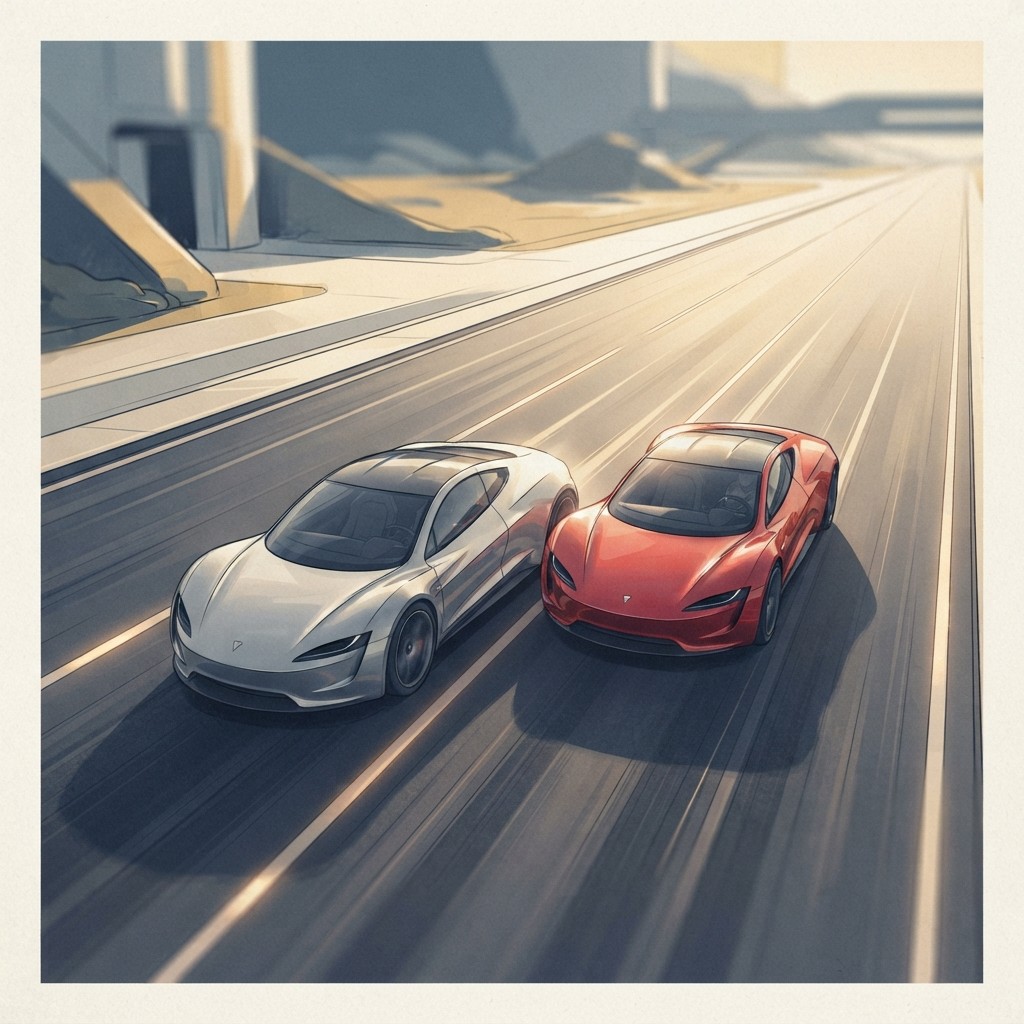
Pairs with the Moat Anatomy Canvas — a ready-to-use strategy tool. Included in the Moat Anatomy Casebook →
“What would it actually cost a challenger to take your customer?”
In October 2011, an interviewer asked Elon Musk about a Chinese company that had just started building electric cars. Musk laughed - on camera - and said he didn't think they had a great product, and didn't see them as a competitor.9 The company was BYD. Thirteen years later, BYD sold more battery-electric cars than Tesla for the first time, and the following year it stretched the lead to more than 600,000 vehicles.5 The laugh aged badly. But it aged badly for a reason worth understanding, because it reveals what Tesla actually had - and what it never did.
The official story is that Tesla built an EV moat: the best cars, the best charging network, a head start nobody could close. The truer story is that Tesla had a head start - a very large, very real one - and confused it for a moat. A head start buys you time. A moat keeps the time from running out. Tesla is now discovering, year by year, that it bought the first and not the second.
The crown was rented, and the lease came due
Start with the number Tesla used to own outright. In 2020, Tesla held more than 70% of the U.S. battery-electric market - close to a monopoly. By 2024 that was about 49%, and by 2025 about 46%.4 That is not a wobble; it is a straight line down across five years, the kind of line that doesn't reverse on its own. Globally, the picture is starker. Tesla's share of the world's BEV market was roughly 19% in 2023 and slipped toward 18% through the first nine months of 2024.6 And against the full EV market - battery and plug-in hybrid combined, a broader denominator than the BEV-only share cited above - Tesla's 2024 deliveries imply something closer to a tenth of all electric vehicles sold worldwide, not the dominant fifth the headline narrative assumes.6 A leader with a moat sees share hold. A leader with a head start sees share converge toward the field as the field arrives.
| A real moat | Tesla's actual trajectory | |
|---|---|---|
| U.S. BEV share | Holds or grows | ~70% (2020) → ~49% (2024) → ~46% (2025) |
| Global BEV rank | Stable #1 | Overtaken by BYD in 2024 |
| Charging network | Proprietary, exclusive | Open standard, shared with rivals |
| Pricing power | Premium sustained | Repeated price cuts to defend volume |
The day Tesla open-sourced its own moat
Of everything Tesla built, the Supercharger network looked most like a true moat - thousands of fast chargers in the places drivers needed them, and a connector only Teslas could use. Owning the only good charging experience in the country is exactly the kind of physical, expensive, hard-to-copy asset that keeps competitors out. So watch what Tesla did with it. In September 2024, Tesla's connector was finalized as SAE J3400 - an open industry standard - and Ford, Rivian, GM, Volvo, and Polestar were granted access to the Supercharger network directly.7 The wall around the garden came down voluntarily. The very feature that locked customers into Tesla became a service Tesla sells to the companies it competes with.
“I don't think they have a great product.”8
This was not strategic generosity; it was the rational move, and that is the point. Opening the network earns third-party revenue and cements the connector as the standard - genuinely smart. But a moat you monetize by selling access to your rivals has stopped functioning as a moat. It is now a toll road. And a toll road is a fine business - it just no longer keeps anyone out. The deeper tell came two months earlier: in May 2024, Tesla fired its entire Supercharger team, including its head, after she resisted demands for layoffs beyond an initial cut.3 New-station deployment cratered 30% year-over-year that quarter to its lowest since late 2021, and full-year 2024 deployments finished about 20% below 2023.2 You do not gut the team building your moat unless you have stopped thinking of it as one.
Why the head start always closes
Here is the mechanism, worked down. A head start in manufacturing is a lead in cumulative learning - Tesla figured out how to build EVs at volume before anyone else. But manufacturing knowledge is the most copyable advantage there is, because it leaks: through suppliers, through poached engineers, through the simple fact that the second mover gets to study a finished product. BYD didn't need to out-invent Tesla. It needed to vertically integrate batteries, undercut on price, and out-build on volume - and it did, crossing $107 billion in total annual revenue and surpassing Tesla's $97.7 billion on that line for the first time.10 Tesla's response has been the response of a company without a moat: cut prices to defend volume, and lean on whatever non-car income it can find. Its 2024 financials show $2.76 billion in regulatory credits - pure margin sold to other automakers - up sharply from the prior year.1 That is not the income statement of an unassailable franchise. It is the income statement of a company working hard to hold its ground.
A head start measured in years means nothing if the underlying advantage copies fast. Manufacturing know-how copies fast - rivals study your finished cars, hire your engineers, and integrate your suppliers. So Tesla's multi-year lead converged quickly the moment serious competition arrived. A true moat divides by something near zero: a cost structure no one can match, or a network nobody can route around. Tesla's most network-like asset, the Supercharger, it converted into shared infrastructure itself.7
The fair objection: maybe the cars were never the point
The strongest counter is that judging Tesla by car share is judging the wrong game. The bull case never rested on out-selling BYD; it rests on software - full self-driving, autonomy, the dream of a car that earns money while you sleep. If that lands, the hardware share war is a sideshow and Tesla's real moat is a fleet of cars generating recurring software revenue no carmaker can match. This is a serious argument, and it might be right. But notice what it concedes: it concedes that the EV lead is not the moat. It moves the entire thesis onto a capability that remains unproven at scale - a promise, not a position. A moat you can point to today and a moat you're betting on for tomorrow are different assets, and only one of them protects you while you wait. The honest read is that Tesla's defensible advantage has migrated from the thing it has demonstrably built to the thing it has demonstrably promised.
The test isn't 'are they ahead?' - it's 'what happens when the field catches up?' A head start is a lead in something copyable: manufacturing skill, distribution reach, a product nobody else has shipped yet. It buys time and nothing more, and the clock starts the moment a serious rival arrives. A moat is a lead in something structurally un-copyable: a cost floor no one can reach, a network too expensive to rebuild, switching costs that punish leaving. The cruel part is that the two look identical at the peak - 70% share looks invincible right up until it's 46%. The diagnostic move: ask what the leader is doing with its hardest-to-copy asset. If it's defending it to the last engineer, it believes it's a moat. If it's open-sourcing it and firing the team, it has already concluded - correctly - that it was only ever a head start.
Tesla did something genuinely historic: it proved electric cars could be desirable, profitable, and built at scale, and it dragged a hundred-year-old industry through the door behind it. That was worth a fortune, and it still is. But proving the road exists is not the same as owning it. The companies that followed got a finished map, and one of them now sells more electric cars than Tesla does.5 The laugh in 2011 wasn't arrogance about a weak competitor. It was the sound of a man mistaking the size of his lead for the depth of his defenses. The head start was real. The moat was always a story told about it - and the next chapter is being written in software Tesla hasn't finished yet.
When a lead turns out to be borrowed
Moat Anatomy Canvas
A one-page canvas that dissects a moat instead of asserting it: where the advantage comes from, how much of the market it covers, how long it would take to copy, and what keeps it from eroding. Blank to dissect your own claimed edge; filled as the worked example tracing the structure of the story's defensible advantage. Use it to tell a real moat from a head start.
Included, filled and blank, in the Moat Anatomy Casebook. See the set → · Preview the blank →
Sources
Where this comes from — the filings, records, and reporting behind it.
- 1Tesla FY2024 total automotive revenues were $77,070M; automotive regulatory credits were $2,763M (up from $1,790M in 2023); total deliveries in Q4 2024 were 495,570 units.
- 2At end of Q4 2024, Tesla operated 6,975 Supercharger stations and 65,495 connectors globally (17% and 19% year-over-year growth, respectively); full-year 2024 new station deployments were ~20% below 2023 levels.
- 3In May 2024, Tesla fired its entire Supercharger team including head Rebecca Tinucci after she resisted Musk's demand for deeper layoffs beyond an initial 15–20% cut; Q2 2024 Supercharger station deployment fell 30% year-over-year to its lowest since Q4 2021.
- 4Tesla held ~48.7% of the U.S. BEV market in 2024, down from ~55% in 2023 and over 70% in 2020; share fell further to ~46% in 2025.
- 5BYD officially surpassed Tesla in global battery-electric vehicle sales for the first time in 2024. In 2025, BYD sold 2.26M BEVs vs. Tesla's 1.64M deliveries (a ~9% year-on-year decline for Tesla), a gap of 600,000+ units. BYD's annual revenue also crossed $100B in 2024, surpassing Tesla's for the first time.
- 6Tesla's global BEV market share was ~19% in 2023 and dropped to ~18% through the first nine months of 2024, per EV Volumes data. Tesla's 2024 global deliveries of 1.79M against ~17M total global EV sales represent approximately 10.5% of the combined BEV+PHEV market.
- 7NACS (Tesla's North American Charging Standard) was finalized as SAE J3400 in September 2024, making it an open industry standard; Ford, Rivian, GM (Cadillac, Chevrolet, GMC), Volvo, and Polestar have been granted access to the Supercharger network, eroding the proprietary lock-in.
- 8Elon Musk openly laughed at BYD during a Bloomberg TV interview in October 2011, saying 'I don't think they have a great product' and that he did not see BYD as a Tesla competitor.
- 9Elon Musk laughed on camera in a Bloomberg TV interview in October 2011 when BYD was raised as a competitor, and said 'I don't think they have a great product'
- 10BYD reported annual revenue of 777 billion yuan ($107 billion) for 2024, exceeding Tesla's $97.7 billion total annual revenue for the first time
Weighing outside help with a decision like this? Hiring a commercial due diligence provider
More like this — beyond Tesla
New Strategically analyses as they publish: the defining moves in business, checked against the record. No noise, and one click to leave.