Core insight
Matching and holding are billed in different currencies: one on every unit you sell, the other only on the units that leave. Converting them into one number, and reading it against how much of your volume the rival can actually reach, usually shows the room was about to approve the most expensive answer.
Why a price war is not a contest of nerve
A price war, as this page uses the term, is a cut a rival has already made against a line you sell. You did not choose the timing, the size or the line. What you choose is the answer.
Matching costs the cut on every unit you already sell, including the units the rival cannot reach and the customers who would have stayed anyway. Holding costs the volume that leaves, at what each unit earned above the cost that leaves with it. The two bills are in different currencies, nothing in the room converts one into the other, and the argument settles on whoever is most frightened.
How much of your volume can you lose before holding costs more than matching, and how much of it can the rival actually reach?
Price both bills, then the third answer
| The answer | What it costs | What you need to know |
|---|---|---|
| Match everywhere | The cut, on every unit in the line, for as long as the war lasts. | Nothing about the rival, which is why rooms default to it. |
| Hold | The volume that leaves, at what each unit earned above the cost that leaves with it. | How much of your volume the rival can serve at the new price. |
| Match where asked | The cut, only on the volume whose customers bring the rival's price in. | The terms: which rivals, what proof, which products. |
| Read the rival's side | Nothing directly. It tells you how long each of the other bills runs. | What the cut costs the rival in its own revenue. |
The decision then reduces to one division: the break-even defection, the share of your volume you can lose before holding costs more than matching. Read it against the rival's reach. If the rival would have to take most of everything it can reach before holding loses, holding is the cheaper answer, whatever it feels like on the sales floor.
A worked example
In the worked case used in the Price War Strategy Pack, a national rival cuts 12 percent into a $180m line at 34 percent contribution, and the room arrives to approve matching everywhere at $21.6m a year. Holding costs $13.0m. The break-even defection is 30 percent of the line and the rival can reach 45 percent, so it would have to take two thirds of everything it can reach. A guarantee invoked with the quote in hand costs $7.6m. The sting is that the 45 percent is a guess from a branch map, and at 75 percent reach holding and matching cost the same.
Matching on every unit: what the cutters and the matchers paid
Tesla made the cut that set off a war. On January 13, 2023 Tesla cut the base Model Y from $65,990 to $52,990, and by April it had cut US prices six times. Tesla's automotive gross margin fell from 32.9% in Q1 2022 to 18.7% in Q3 2023. Tesla delivered 1,808,581 vehicles in 2023, up 38%, while its total gross profit shrank from $20.85 billion to $17.66 billion. By 2025 Tesla's deliveries had fallen to 1,636,129, a second consecutive annual decline.
NIO is the matcher that said it would not match. In April 2023 NIO's CEO, William Li, said thin gross margins kept NIO out of the price war. On June 12, 2023 NIO cut prices by RMB 30,000 across all models and ended free battery swaps for new buyers. In 2024 NIO delivered a record 221,970 vehicles and lifted its vehicle margin from 9.5% to 12.3%, and NIO's net loss still widened to RMB 22.4 billion.
Blockbuster matched the one thing Netflix had abolished. In 2000 Blockbuster collected nearly $800 million in late fees, about 16% of its revenue. Blockbuster's 2005 push to eliminate late fees drew settlements with attorneys general in 47 states, Blockbuster reinstated late fees in 2010, and it filed for Chapter 11 on September 23, 2010.
Every unit in the line pays the cut, including the customers who were never going to leave. That is why matching everywhere should be the last answer priced, not the first one approved.
The rival's side: who can afford the war decides how long it lasts
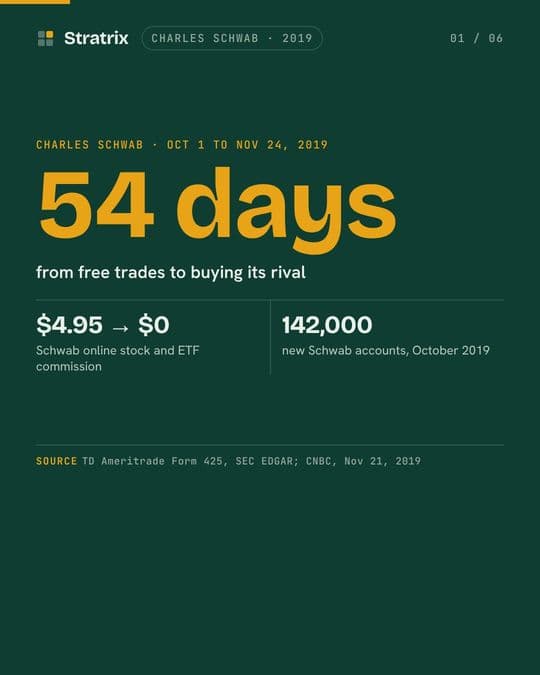
Charles Schwab cut online trade commissions from $4.95 to zero in October 2019. Schwab's CFO put the cost at roughly $90-100 million a quarter, about 3-4% of total net revenue. Commissions were about 15-16% of TD Ameritrade's revenue, and TD Ameritrade's shares fell 25.8% on the day of the announcement.
On November 24, 2019, 54 days after the announcement, Schwab agreed to acquire TD Ameritrade for roughly $26 billion in stock. The combined Schwab closed the deal in October 2020 with about $6 trillion in client assets across 28 million brokerage accounts. The same cut was a small line for the side that made it and a large one for the side that faced it.
Schwab could carry the cut because its money was elsewhere: by that same disclosure, commissions were only about 4% of Schwab's revenue, while the larger business was the spread on swept client cash.
BYD cut prices on its best-selling models by 10 to 20% in early 2024 and framed the cut as lower cost rather than lower margin. BYD's 2024 net profit rose 34% to 40.25 billion yuan on 4.27 million vehicles. In 2025 BYD's net profit fell 19% to 32.62 billion yuan and gross margin narrowed from 19.44% to 17.74%, with management citing the domestic price war as the main cause.
Before deciding whether you can outlast a cut, find what it costs the side that made it, as a share of that side's own revenue. If it is small for them and large for you, the war lasts as long as they want it to.
The third answer: match only where the customer asks
Best Buy made a price-match guarantee permanent on March 3, 2013, across its 1,000-plus big-box stores and 400-plus Best Buy Mobile stores, matching 19 named online competitors with Amazon on the list. A guarantee puts the lower price on the customers who bring the rival's price to the register, not on every unit in the line.
It was not free. Best Buy's gross margin declined from 25.1% to 22.4% between 2010 and 2014, and Best Buy ran a cost program alongside it: Renew Blue annualized cost reductions reached $1.02 billion by the end of fiscal 2015. Best Buy also stopped fighting on price alone, and by fiscal 2014 it had opened 1,400 Samsung and 600 Windows stores-within-a-store, selling the floor to the vendors whose products shoppers came in to see.
Alibaba shows the opposite end of the reach question. In 2003 eBay acquired EachNet, then holding an 85-percent share of China's C2C market, and Alibaba answered with Taobao and free listings against eBay's fee-based model. By 2006 eBay had shut its standalone China operations. When a rival can reach your whole base, holding is priced at everyone leaving.
What these cases show
Each case is drawn from the Stratrix case library and checked against the filings and reporting listed under Sources. Several are read from the side that cut rather than the side that answered. The last column says what each one does not establish.
| Company | What it did | What happened | What it does not establish |
|---|---|---|---|
| Tesla, 2023 | Cut first, six times by April | Automotive gross margin from 32.9% to 18.7%; deliveries down again in 2025 | Whether the cuts bought volume that holding would have lost |
| NIO, 2023 | Matched after saying it would not | Vehicle margin up to 12.3% in 2024; net loss of RMB 22.4 billion | What holding would have cost NIO in deliveries |
| Blockbuster, 2005 | Matched Netflix by dropping late fees, about 16% of revenue in 2000 | Late fees reinstated in 2010; Chapter 11 the same year | That matching caused the bankruptcy |
| Charles Schwab, 2019 | Cut commissions to zero at about 3-4% of its revenue | Agreed to buy TD Ameritrade 54 days later for about $26 billion | That the cut, rather than other terms, forced the sale |
| BYD, 2024 | Cut 10-20% through lower cost | Net profit up 34% in 2024, down 19% in 2025 | How long a cost advantage outlasts a market-wide war |
| Best Buy, 2013 | A guarantee against 19 named online rivals | Gross margin from 25.1% to 22.4% between 2010 and 2014 | How much of the margin went on matching rather than mix |
| Alibaba and eBay in China, 2003 | eBay kept its fees against free listings | eBay shut its standalone China operations by 2006 | That a lower fee would have saved eBay's position |
Running the decision
A sequence for the team answering the cut
Read the cut
Which line, how deep, on what terms, and whether it is a price or a promotion with an end date.
Price matching everywhere
The cut on every unit in the line, for as long as you expect the war to last. This is the number the room already has.
Count the rival's reach, by account
Their branches, their capacity, the terms attached to the price, and who they are calling on. It is a week with sales operations, and until it exists the room is pricing the war at everyone leaving.
Compute the break-even defection
The share of your volume at which holding costs what matching does. Read it against the reach, and sweep the share that leaves rather than guessing one figure.
Price the guarantee
Matching only where the customer brings the rival's price in. Design the terms before anyone announces it.
Read the rival's side
What the cut costs the rival in its own revenue. The side for whom the cut is cheap decides how long the war lasts.
What this method cannot tell you
It assumes a matched price keeps the customer, which is a simplification. It does not forecast the share of volume that leaves; that is your own evidence, which is why the share should be swept rather than settled in advance. And it prices this war, not the next one: what a public match teaches a rival is a judgment, not a number.
The cases support recognizing the mechanism, not a rate of success for any answer. None of them is a controlled test, several are read from the side that cut, and this page does not claim to know what any of them would have looked like had the other side answered differently.
Watch these decisions
Short videos built from the same Decision Records as this page.
Questions
A competitor cut prices. Should we match?
Price both bills first. Matching costs the cut on every unit you sell; holding costs only the volume that leaves, at what each unit earned. Then compare the share of volume you could lose before holding costs more with the share the rival can actually reach.
What is the break-even defection in a price war?
The share of your volume you can lose to the rival before holding your price costs more than matching theirs. If the rival would have to win more than that, from the customers it can actually serve, holding is cheaper.
How do you win a price war?
Usually by being the side for whom the cut is cheap. Charles Schwab's 2019 commission cut cost Schwab about 3-4% of revenue while commissions were about 15-16% of TD Ameritrade's, and Schwab agreed to buy TD Ameritrade 54 days later.
Is a price-match guarantee better than cutting the list price?
Often, because it puts the lower price only on the customers who ask for it. Best Buy made a guarantee permanent in 2013 against 19 named online competitors and paired it with a cost program to cover the margin it gave up.
How long do price wars last?
As long as the side for whom the cut is cheap wants them to. Read the cut in the rival's own revenue rather than yours, and set in advance the point at which you would change your answer.
Continue learning
Sources & further reading
- Charles Schwab Corporation (2019). Schwab Removes the Final Pricing Barrier to Investing Online by Eliminating U.S. Stock, ETF and Options Commissions.
- NPR (2019). Charles Schwab, TD Ameritrade And E-Trade Cut Trading Commissions To Zero.
- CNBC (2019). Charles Schwab is ending commissions on stock trading and the brokerage shares are tanking.
- TD Ameritrade Holding Corporation (Form 425) (2020). Merger Proxy Supplement.
- TD Ameritrade Holding Corporation (Form 8-K) (2020). Schwab Completes Acquisition of TD Ameritrade.
- Quartz (2019). Charles Schwab is cutting brokerage fees to zero, but that doesn't mean it's free.
- Retail Dive (2013). Best Buy price-matching to become a year-round policy.
- Indigo9 Digital (2021). How Best Buy Made a Stunning Turnaround.
- Best Buy Co., Inc. (Form 8-K) (2015). Best Buy Reports Fourth Quarter Results (FY2015).
- Best Buy Co., Inc. (Form 8-K) (2014). Fiscal Year 2014 Earnings Release.
- InsideEVs (2023). Big US Tesla Price Reduction Across The Range, Some Models Are 20% Cheaper.
- CNBC (2023). Tesla cuts U.S. prices for sixth time this year ahead of first-quarter results.
- Tesla, Inc. (Form 10-Q) (2023). Form 10-Q for the quarters ended March 31 and September 30, 2023.
- Tesla, Inc. (Form 8-K) (2024). Q4 2023 Financial Results.
- Tesla, Inc. (Form 8-K) (2026). Tesla Fourth Quarter 2025 Production, Deliveries & Deployments.
- TechCrunch (2023). Nio said not to join China's EV price war. Now it's cutting $4K across all models.
- NIO Inc. (2025). NIO Inc. Reports Unaudited Fourth Quarter and Full Year 2024 Financial Results.
- NBC News / Associated Press (2010). Hubris and late fees doomed Blockbuster.
- California Department of Justice (2005). Attorney General Lockyer Announces Settlement With Blockbuster Over 'No Late Fees' Program.
- CNBC (2020). Netflix didn't kill Blockbuster: how Netflix almost lost the movie rental wars.
- Blockbuster Inc. (Form 8-K) (2010). Bankruptcy Filing Disclosure.
- CKGSB Knowledge (2026). BYD's EV Strategy and China's NEV Market Leadership.
- Gasgoo Auto News (2025). BYD scores YoY jump in 2024 annual revenue, net profit.
- CnEVPost (2026). BYD's 2025 net profit drops 19% as domestic price war bites.
- INSEAD Knowledge (2022). Alibaba vs. eBay: Competing in the Chinese C2C market.
- IMD Business School (2022). Alibaba vs. eBay: Competing in the Chinese C2C market.
More to learn
Other foundational guides worth reading.
Pricing Model Change: How to Move to Subscription or Usage Pricing
A pricing model change moves up to four layers at once: the unit you charge for, the shape of the cash, the buyer who signs, and the promise the customer relies on. Name which ones you are moving, size the trough against carrying on unchanged, and run the case again with the volume uplift set to zero.
Pricing StrategyFree Tier Strategy: When Does Freemium Pay for Itself?
A free tier pays for itself when the share of free users who start paying each year clears the break-even conversion rate: what one free user costs a year, net of what they earn, divided by what one conversion is worth. The paying-over-total ratio in most decks is not that rate, and some free tiers are paid for by another side of the market or by a layer sold on top, not by converts.
Pricing StrategyProduct Bundling Strategy: When to Sell Together or Apart
A bundle first hands its discount back to every customer already paying for both products, and earns only on the customers it adds and the extra years bundled customers stay. Match the two customer lists to size the handback, measure the retention gap, and solve for the deepest discount at which selling together still beats selling apart.
Pricing StrategyPrice Increase Strategy: How Much Volume Can a Rise Afford to Lose?
A price rise is decided by two numbers. The share of volume it can afford to lose is arithmetic on the rise and your contribution margin; the share it will lose comes from measuring your own last rise against the trend before it. Raise as far as the gap between them allows, net of what the field discounts away.
Change & TransformationTurnaround Plan: How to Tell a Real Turnaround from a Cost Program
A turnaround that gives up nothing is a cost program wearing a turnaround's name. The test is what the plan surrenders, what each surrendered dollar has to come back as, and whether that happens inside the time the board, the lenders and the cash allow.
Strategy FundamentalsVision, Mission, and Values
How to craft the foundational statements that align your organization—and why most get them wrong.
See this framework in the wild.
Follow it across the companies and lenses where it actually shaped the strategy.