Core insight
Every pricing model change moves at least one of four layers: the unit, the cash shape, the buyer, or the promise. Each layer has a different owner inside the company, none of them is the pricing team, and the change only pays once the trough it opens has been crossed.
Why a pricing model change is not a pricing decision
Raising a price moves revenue this quarter and can be reversed next quarter. Changing the model alters what a unit of your product is, when you are paid for it, who inside the customer signs, and what they are now free to stop buying. Each of those has a different owner inside your company, and none of them is the pricing team.
So the business case for a new model usually contains two arguments made by different people: a revenue argument about the new unit, and a cash argument about the transition. They arrive in the same paper and are rarely reconciled.
What does changing how you charge cost before it starts paying, and which of the four layers is that cost coming from?
The four layers a change can move
| The layer | What moves when it changes | The signal it is going wrong |
|---|---|---|
| The unit | The bill starts moving with something new. | The customer cannot forecast next year's bill from it. |
| The cash shape | The trough: a fraction booked now of what you used to book. | The cumulative gap approaches the facility, and no one has that on a monthly line. |
| The buyer | The sales motion, and the budget the signature comes from. | Deals stall above what the new buyer can approve alone. |
| The promise | Churn that did not exist. A sale becomes an annual re-decision. | The first real renewal cohort comes in below a projection no one had evidence for. |
Most changes move more than one layer, and the one nobody owns is the one that goes wrong. A move from perpetual licenses to subscription changes the cash shape and the promise together; a move from seats to usage changes the unit and often the buyer.
The unit: can the customer forecast the bill?
Oracle replaced its usage metrics for Java SE in January 2023 with a single price per employee, counting every employee whether or not they used Java. Gartner estimated the new subscription would cost most organizations two to five times more for the same usage, and a 2025 survey found nearly eight in ten organizations moving away from Oracle Java.
A new unit is also a new incentive to stop counting. HubSpot moved from a flat fee per product to per-seat pricing in March 2024, capping its free tools at five editing seats and making every further editor a paid seat. Seat pricing ties growth to the customer's headcount, which is the point and also the exposure.
The cash shape: size the trough before you start
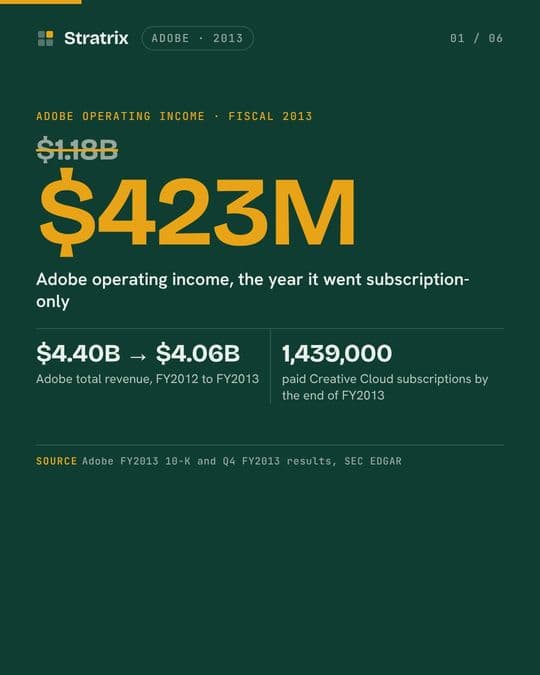
Adobe's move to subscription-only Creative Cloud in May 2013 is the most documented trough. In fiscal 2013 product revenue fell from $3.34 billion to $2.47 billion and operating income fell from $1.18 billion to $423 million, because subscription revenue is recognized month by month while a perpetual license was booked at sale.
Adobe crossed in a year. In fiscal 2014 subscription revenue of $2.08 billion overtook product revenue of $1.63 billion for the first time, and total revenue recovered to $4.15 billion. It could afford the trough partly because, as its optional subscription had already shown, customers had nowhere better to go.
The trough, in three numbers
Depth: the worst single year against carrying on unchanged. Duration: the years until the new model is ahead. Cumulative gap: the cash the transition consumes, and the figure most often missing from the paper. Then run the whole case again with the volume uplift set to zero.
The zero-uplift run matters because most transition cases quietly assume more customers will buy once the entry price falls. In the worked case used in the Pricing Model Change Strategy Pack, the subscription is priced well above what a legacy customer was worth per year, so converting the installed base looks excellent, and the change still does not cross without a volume uplift no one has measured.
The buyer: who can sign alone?
Microsoft launched Microsoft 365 Copilot at $30 per user per month with a 300-seat minimum for commercial customers. In January 2024 it removed the minimum and kept the $30 price, letting firms buy as few as one seat. The floor, not the price, had been blocking cautious buyers who wanted a small pilot they could approve themselves.
The promise: what customers are now free to stop
Changing the model often breaks something customers were told. Netflix said in 2019 that being advertising-free remained a deep part of its brand. After its subscriber loss in 2022 it reversed, and on November 3, 2022 launched Basic with Ads at $6.99 a month in 12 countries.
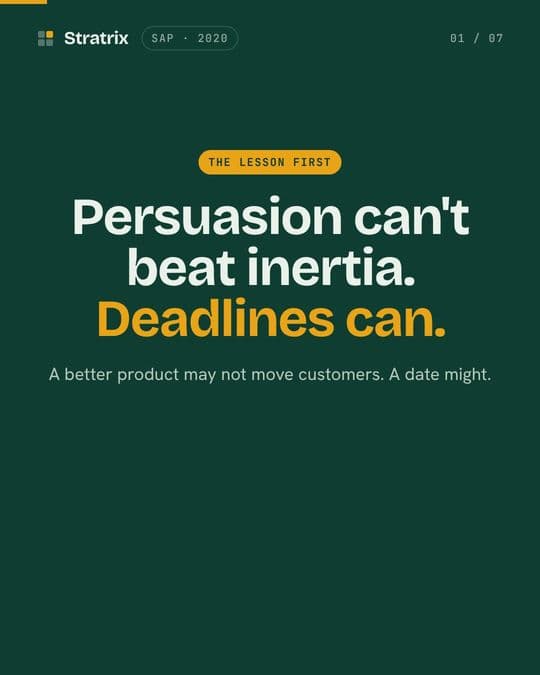
Some companies change the promise by removing the alternative. Atlassian said in 2022 that it had no plans to end its self-managed Data Center product; in September 2025 it set an end-of-life date of March 28, 2029. SAP set the end of ECC support so that security patches stop after 2030, and by the end of 2024 only about 14,000 of its 35,000 ECC customers had migrated.
A deadline converts customers, but it also starts the clock on whether they stay. After Broadcom bought VMware for $84.2 billion, it ended perpetual licenses and customers reported price rises of up to twelve times. Gartner inquiries about VMware alternatives rose 275% year over year, and roughly half of VMware's midmarket base let licenses lapse around the acquisition.
What these changes show
Each case is drawn from the Stratrix case library and checked against the filings and reporting listed under Sources. The last column says what each one does not establish.
| Company | Layers moved | What happened | What it does not establish |
|---|---|---|---|
| Adobe, 2013 | Cash shape and promise | Operating income fell to $423 million in fiscal 2013; subscription overtook product revenue in fiscal 2014 | That a company without Adobe's position could absorb the same trough |
| Oracle, 2023 | The unit: per employee | Java bills two to five times higher; nearly eight in ten organizations moving away by 2025 | How much of the move away has happened rather than been planned |
| HubSpot, 2024 | The unit: per seat | Free tools capped at five editing seats | Any outcome; none is dated yet |
| Microsoft, 2024 | The buyer: removed the 300-seat floor | Copilot kept its $30 price and opened to single-seat purchases | How many small buyers it added |
| Netflix, 2022 | The promise: ad-free | Basic with Ads launched at $6.99 in 12 countries | What the ad tier earns against the plans it displaced |
| Atlassian, 2025 | The promise: self-managed | Data Center end of life set for 2029 | How many customers move rather than leave |
| SAP, 2020 | The promise: on-premise support | About 14,000 of 35,000 ECC customers migrated by the end of 2024 | Whether the deadline holds; SAP has moved it before |
| Broadcom, 2023 | Unit, cash shape and promise at once | Inquiries about alternatives up 275%; about half the midmarket base lapsed | How many of those customers have left |
Running the decision
A sequence for the team making the change
Name the layers
Unit, cash shape, buyer, promise. Write down which ones this change moves, and who in your company owns each.
Size the trough
Depth, duration and cumulative gap, against carrying on unchanged rather than against today's revenue.
Run it at zero uplift
If the change only crosses with more customers than you have today, the case is a growth bet and should be argued as one.
Check the buyer
Can the person who now signs approve the first purchase alone? If not, find the floor that blocks them.
Fix the compensation plan before launch
Sales teams paid on bookings will see the trough first, as a pay cut.
Set the stop triggers
The renewal rate, migration rate and cumulative gap at which you would slow or reverse, decided before the first customer moves.
What this method cannot tell you
Pricing outcomes are attributed after the fact by people who were not indifferent about them, and no counterfactual exists for any of the cases above, including for the companies themselves. The cases support recognizing a mechanism. They cannot support a success rate, and this page does not claim one.
It also does not tell you what to charge. It tells you what the change costs before it pays, and which part of the company will feel that cost first.
Watch these decisions
Short videos built from the same Decision Records as this page.
Questions
What is a pricing model change?
A change to how a company charges rather than how much: from perpetual licenses to subscription, from seats to usage, from a lump sum to an annuity, or from free to paid. It moves the unit, the cash shape, the buyer or the promise, not just the price.
How do you move customers from perpetual licenses to subscription?
Size the revenue trough first, because subscription revenue is recognized over time while a perpetual license was booked at sale. Then decide the pace: an optional subscription period, a parallel period, or a hard end-of-support date, each with stop triggers set in advance.
How long does a subscription transition take to pay back?
It depends on the depth of the trough and on renewals, and it should be computed rather than assumed. Adobe's subscription revenue overtook its product revenue about a year after it went subscription-only in 2013.
What is the risk of switching from seat-based to usage-based pricing?
The unit changes, so customers may no longer be able to forecast their bill, and the buyer may change too. Watch for whether customers can predict next year's bill and whether the person who now signs can approve the purchase alone.
Can a pricing model change be reversed?
Some can. Unity canceled its per-install runtime fee a year after announcing it and returned to seat pricing. A promise that has been broken, such as ending a self-managed product, is much harder to restore.
Continue learning
Sources & further reading
- Adobe Systems Incorporated (2014). Form 10-K, fiscal 2013.Product revenue fell from $3.34 billion to $2.47 billion; operating income from $1.18 billion to $423 million.
- Adobe Systems Incorporated (2015). Form 10-K, fiscal 2014.
- Adobe Systems Incorporated (2013). Form 10-K, fiscal 2012.
- The Register (citing Gartner) (2023). Oracle's revised Java licensing terms 2-5x more expensive.
- Flexera (2023). What you need to know about the new Oracle Java licensing.
- InfoWorld (2025). Oracle's Java licensing shift sparks mass migration to open source.
- HubSpot (2024). Upcoming changes to HubSpot's pricing.
- BluLeadz (2024). HubSpot's Evolving Pricing Model.
- CNBC (2023). Microsoft 365 Copilot price tag revealed.
- TechCrunch (2024). Microsoft removes the 300-seat minimum for Copilot for Microsoft 365.
- Variety (2020). Netflix CEO Reed Hastings Reiterates No Interest in Ad Business.
- Variety (2022). Netflix Announces Ad-Supported Plan Launch Date, Pricing.
- Atlassian (2022). What's new and what's ahead for Data Center: June 2022.
- Atlassian (2025). Ascend to the cloud: The next chapter for Atlassian and our customers.
- SAP PRESS (2026). SAP S/4HANA Overview.
- CIO (citing Gartner) (2025). Nearly half of SAP ECC customers may stick with legacy ERP beyond 2027.
- Support Revolution (2026). SAP Support Deadline Extended Yet Again to 2027.
- Broadcom Inc. (Form 10-Q) (2025). Form 10-Q referencing the VMware acquisition.
- CIO Dive (citing Gartner) (2024). VMware's first contentious year under Broadcom drives customers to weigh other options.
- Network World (2025). Broadcom changes VMware pricing amid customer backlash and EU questioning.
- Unity Technologies (2024). Unity is Canceling the Runtime Fee.
More to learn
Other foundational guides worth reading.
Price War Response: When to Match a Rival's Price Cut, or Hold
Matching a rival's cut costs the cut on every unit you sell; holding costs only the volume that leaves. Work out the share of volume you can lose before holding costs more than matching, compare it with how much of your volume the rival can actually reach, and price a guarantee that matches only where customers ask.
Pricing StrategyPrice Increase Strategy: How Much Volume Can a Rise Afford to Lose?
A price rise is decided by two numbers. The share of volume it can afford to lose is arithmetic on the rise and your contribution margin; the share it will lose comes from measuring your own last rise against the trend before it. Raise as far as the gap between them allows, net of what the field discounts away.
Pricing StrategyFree Tier Strategy: When Does Freemium Pay for Itself?
A free tier pays for itself when the share of free users who start paying each year clears the break-even conversion rate: what one free user costs a year, net of what they earn, divided by what one conversion is worth. The paying-over-total ratio in most decks is not that rate, and some free tiers are paid for by another side of the market or by a layer sold on top, not by converts.
Pricing StrategyProduct Bundling Strategy: When to Sell Together or Apart
A bundle first hands its discount back to every customer already paying for both products, and earns only on the customers it adds and the extra years bundled customers stay. Match the two customer lists to size the handback, measure the retention gap, and solve for the deepest discount at which selling together still beats selling apart.
Growth & ExpansionExpansion Plan: How Fast Can a Rollout Actually Go?
Plans express themselves as destinations: two hundred stores, twelve countries. A destination cannot be wrong, only late. A rate can be checked, and most expansions fail because the rate was faster than the operation behind it could carry.
Change & TransformationTurnaround Plan: How to Tell a Real Turnaround from a Cost Program
A turnaround that gives up nothing is a cost program wearing a turnaround's name. The test is what the plan surrenders, what each surrendered dollar has to come back as, and whether that happens inside the time the board, the lenders and the cash allow.
See this framework in the wild.
Follow it across the companies and lenses where it actually shaped the strategy.