Our read

The frame on the card is our argument, and it is labeled as one.

The receipt

Every card carries one checkable number, with its source named on the card.

Where it breaks

Every frame says where it stops being true. That part is not a footnote.

Fault Lines card: Corporate cash is splitting into two strategies.
Fault Line · split

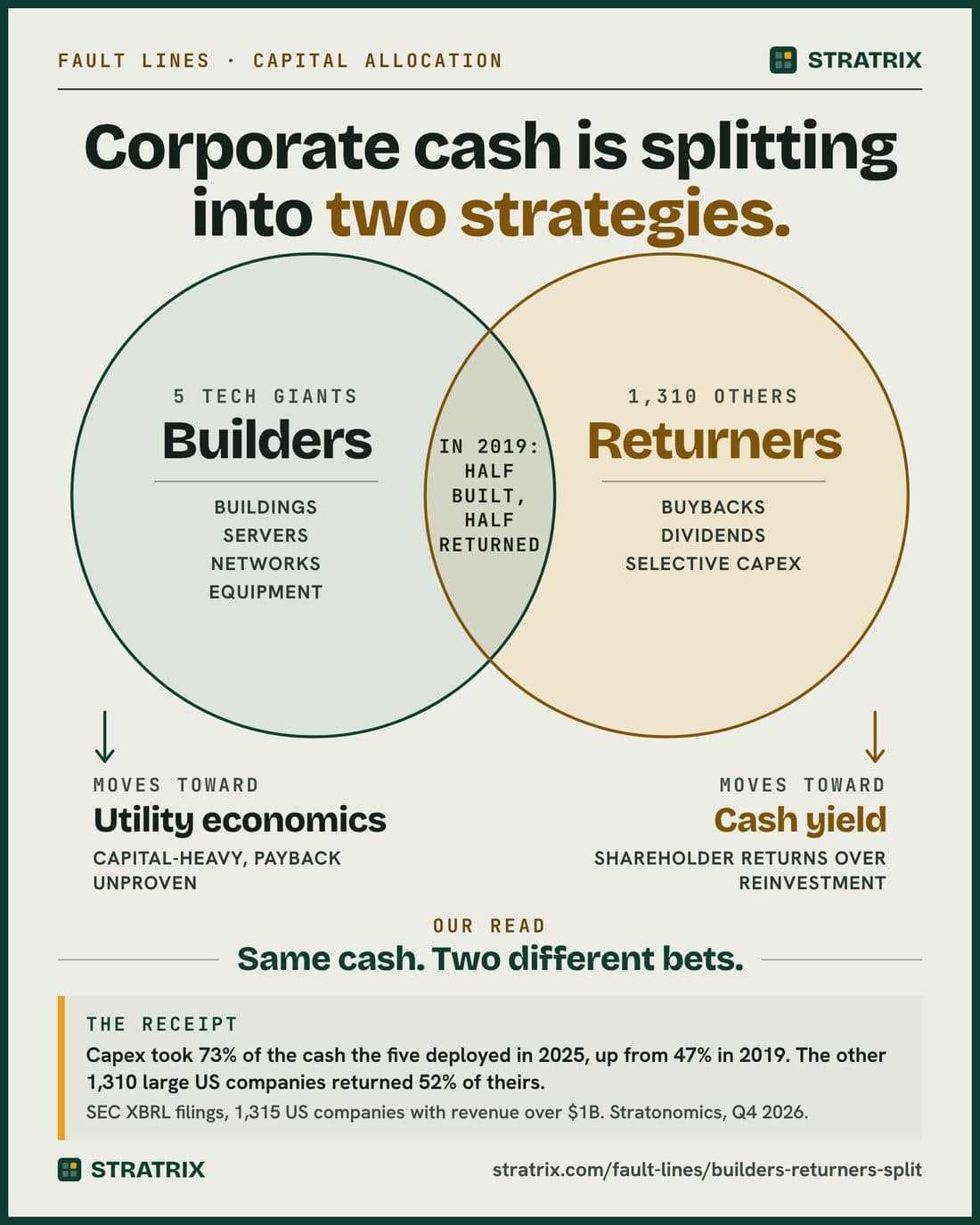
Corporate cash is splitting into builders and returners

In 2019, even the biggest spenders in tech split their cash about evenly between building and handing it back. By 2025, large US companies had sorted themselves into two camps, and each camp is exposed to a different mistake.

Here is our read. Capital allocation used to be one playbook: build some, return some, keep the balance sheet tidy. That playbook has split. Five companies now invest like utilities. Almost everyone else runs as a cash machine for shareholders. Neither is wrong. But a company that drifted into a camp without choosing it carries a risk it never priced.

Capex took 73% of the cash the five deployed in 2025, up from 47% in 2019. The other 1,310 large US companies returned 52% of theirs.SEC XBRL filings, 1,315 US companies with revenue over $1B. Stratonomics, Q4 2026.

Where the frame breaks: "everyone else" is not one bloc. Utilities put 79% of their cash into capex, telecom 55% and energy 48%, while technology companies outside the five returned 66%. The five did not stop returning cash either: $136 billion in 2025, more than the $78 billion of 2019. And the utility comparison ends at the spending. A utility earns a return a regulator sets. The five earn whatever customers pay for the capacity, after they have paid for it.

Is your company a builder or a returner, and did anyone decide that on purpose?
Read the evidence and place your own company →

Fault Lines card: The announcement is the smallest part of a deal.
Fault Line · iceberg

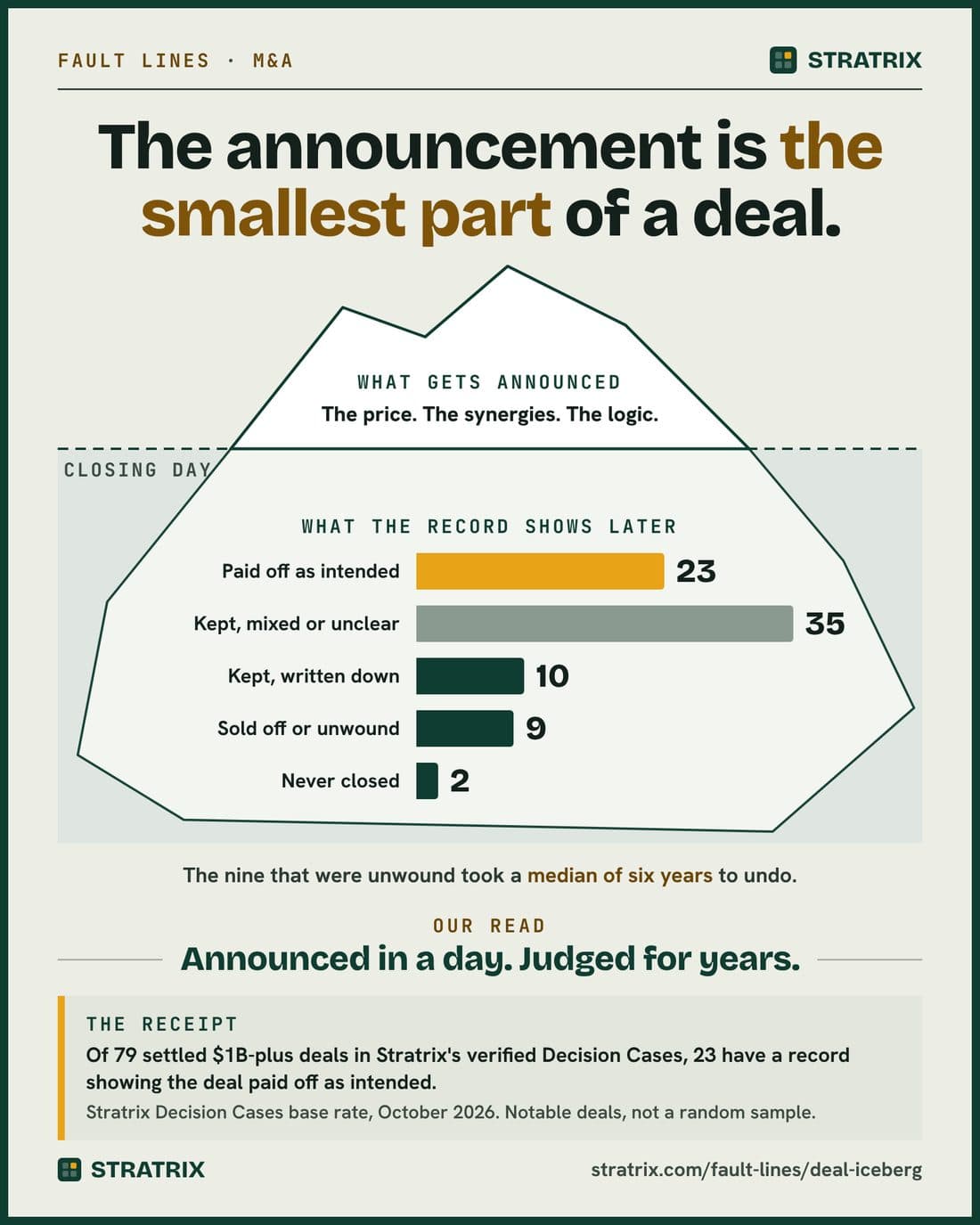
The announcement is the smallest part of a deal

A billion-dollar acquisition gets graded on the day it is announced: the price, the synergies, the logic. The record of what happened next is bigger, slower and much less flattering.

Our read: boards and markets judge deals at the tip, where the information is thinnest. The part that decides a deal sits below the waterline and takes years to surface. That makes announcement day the wrong moment to feel finished, and the wrong moment to stop asking what the deal has to prove.

Of 79 settled $1B-plus deals in Stratrix's verified Decision Cases, 23 have a record showing the deal paid off as intended.Stratrix Decision Cases base rate, October 2026. Notable deals, not a random sample.

Where the frame breaks: these are notable decisions documented in our records, not a random sample of all deals, so famous successes and famous failures are both overrepresented. Mixed or unclear is not failure; for 35 deals the record simply does not settle the question. And a deal unwound is not always a mistake. Some exits harvested the value the deal created.

The last big deal your company announced: what would its record say today?

Read the evidence and place your own company →