Our read
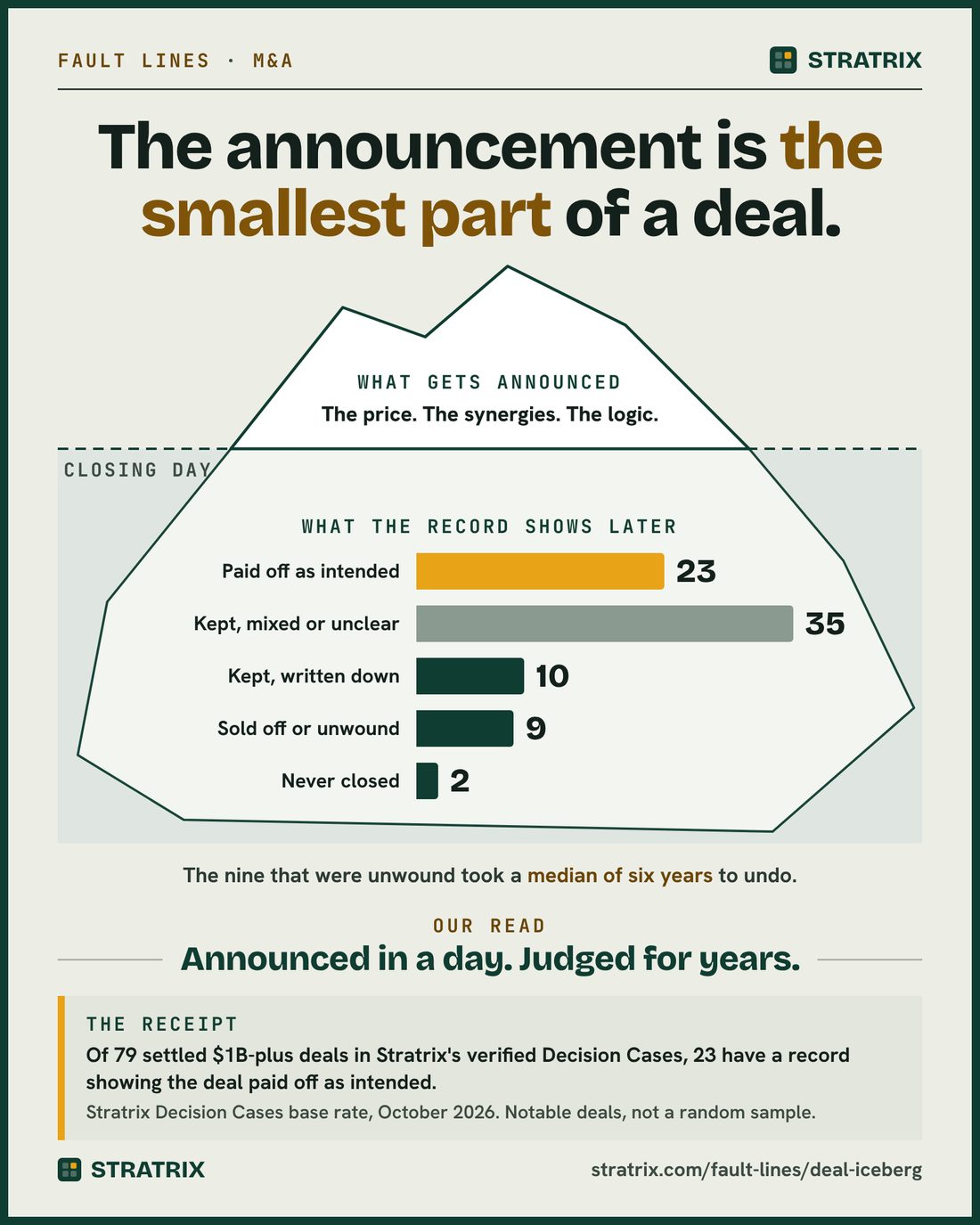
Boards, markets and the press grade an acquisition on the day it is announced, when the information is thinnest: a price, a synergy figure, a strategic logic. The part that decides the deal sits below the waterline. It surfaces over years, long after the announcement was judged.
That is the fault line. The moment of most attention and the moment of most knowledge are years apart, and most of the work of a deal process (the model, the board deck, the press release) is built for the first of them.
Announced in a day. Judged for years.
The evidence
Stratrix counted every verified Decision Case in which a company committed $1 billion or more to an acquisition or merger: 88 deals, each counted once however many records tell it. 9 are too recent to call. Each of the other 79 is placed in one outcome by the words of its own record.
The 9 deals that were later sold off or unwound took a median of 6 years from the deal to the exit, the fastest 3 and the slowest 23.
Taken together, 21 of the 79 were written down, undone or never closed. Set that beside the 23 that clearly paid off and the 35 whose record cannot say.
- Paid off as intended: Google–YouTube (2006), Facebook–Instagram (2012), IBM–Red Hat (2019).
- Sold off or unwound: eBay–Skype (2005), Google–Motorola Mobility (2011), AT&T–Time Warner (2016).
The full record → Every deal behind these counts, with the line from its record that places it.
Where the frame breaks
These are notable deals, not a random sample. The cases are decisions documented well enough to verify, which leans toward deals famous enough to be written about. That over-represents both the spectacular failures and the celebrated wins. Read the counts as what happened in these cases, not as the odds for yours.
Mixed or unclear is not failure. For 35 deals the record does not settle whether the deal worked. Absence of proof that a deal paid off is not proof that it did not.
Undone is not always a mistake, and kept is not always a success. Some exits harvested value the deal had created. Some deals that were kept never did what they promised, and the record does not say so in a way we can count.
What to do before the next announcement
- State the rationale as something the record could confirm. "Strategic fit" cannot be checked later. "Adds a channel we do not have, worth a stated share of revenue by a stated year" can. If the reason for the deal cannot be written so that a future record could confirm or refute it, it is a hope, not a thesis.
- Schedule the reviews across the years that decide the deal. The undoing took a median of 6 years. A single post-close review in the first year looks at the tip. Set the checkpoints across the span in which deals are actually decided, and name who outside the deal team will run them.
- Write down what would make you sell. An exit test agreed before closing (the result that would lead you to sell, and by when) is easier to honor than one argued after a write-down. Of the 9 deals later unwound in this record, none took fewer than 3 years.
Place your own deal
The record above is everyone else's deals. The next step is yours.
Get the next Fault Line, and the rest of Stratrix's analysis, by email.