Licensed to an organization: checkout asks for the company the purchase is for, its website, and an email address to deliver the files to. A work address is best for the license record; a personal one is accepted. Digital download. All sales are final: no refunds or returns. Each format can be downloaded 3 times, and the links stay valid for 30 days. If you need more, reply to your confirmation email and we will sort it out.
Every business inside your company was entered on a written case. It exists, it is dated, and somebody's name is on the forecast. The case for leaving has never been written, because writing it is nobody's job and volunteering to write it is career-limiting — so the case for staying is refreshed annually by people rewarded for producing it, and the business runs until its losses become impossible to defend in a bad year. This pack computes the burn: the operating loss plus the capital the business absorbs, which almost never appear in the same sentence, stated at your own multiple. It prices leaving today, and how many years of patience that buys. Then it computes the same exit at the end of your own estimate of breakeven, with the burn spent waiting added and what a buyer would pay thinned, and returns the difference. It stops on four conditions: nobody has priced leaving, nobody has said how long until it stops losing money, nobody has said how fast a buyer's price thins, and nobody has said what it would cost to be back in.
What is the Exit Strategy Pack
The Exit Strategy Pack is a complete decision-support kit for one question: what would it cost to leave this business, and what does waiting cost if you leave anyway? It is built around one organizing claim: every business inside a company was entered on a written case, and almost none has ever had a case written for leaving. Sixteen files carry it: the foundations, a concept deck, a scored decision wizard, an exit model blank and worked, the moves at each position, nine sourced exits, a fit worksheet, a roadmap template, a practitioner manual, a field checklist, and an orientation page.
The test that runs through every file
Every company has a written case for entering a business and none for leaving one, so exits happen by exhaustion rather than by decision — and the cost of leaving grows every year the decision is not taken. It is the argument in the deck, it becomes the wizard’s axes, it drives the model’s inputs, and it reappears as lines on the checklist. That is what makes 16 files a product rather than 16 documents.
The model resolves to one number you can negotiate with: The price of the delay — what waiting costs if you leave anyway. It ships blank and worked, and every input is a named cell rather than a figure buried inside a formula, so the number arrives with its assumptions attached rather than on its own authority.
Why the argument about exiting a business never resolves
Because the comparison is always staying against leaving now, and never leaving now against leaving later. The case for staying is refreshed annually by people who are rewarded for producing it. The case for leaving is no one's job, and volunteering to write it is career-limiting. So the decision is not taken — it arrives, in the quarter the losses become impossible to defend, with the fewest buyers and the least time.
This pack turns that into arithmetic. It computes the burn and states it at your own multiple. The burn is the operating loss plus the capital the business absorbs, two figures that almost never appear in the same sentence. It prices leaving today. Then it computes the same exit at the end of your own estimate, with the burn spent waiting added and what a buyer would pay thinned, and returns the difference: the price of the delay.
What is in the Exit Strategy Pack
- Foundations. The framework: the asymmetry, the burn, what leaving costs, the price of the delay, and the four halts.
- Concept deck. Twenty-two slides for a board or portfolio session, with nine sourced exits and what each does not establish.
- Decision wizard. Eight scored questions returning the band, the weakest answer, and either of the two halt conditions.
- Exit model. Eleven candidate years to breakeven across the columns, the cost of leaving in each of them, and the price of the delay.
- Strategies and tactics. The moves at each of the four positions, what to do when the model halts, and four ways to make the next exit cheaper to decide.
- Case studies. Nine sourced exits — one that took forty years, one that cost $400 million to hand a division away, one company that did the same trade twice.
- Fit worksheet. The single page of record: the burn, the exit price, the buyer, the price of the delay and the date.
- Roadmap template. Five phases with gates and owners, the assumptions register, a trigger and a periodic reporting line.
- Practitioner manual. Adding the capital to the loss, pricing the exit, the estimate's history, the board paper, six failure modes and their indicators.
- Field checklist. The one-pager that survives outside the binder.
- About the package. What each file does and the order in which to run them.
Who the Exit Strategy Pack is for
A chief executive holding a division that has been two years from breakeven for six; a chief financial officer who has never seen the exit priced; a board member reading the fourth plan for the same business without the first one beside it; a strategy team that would rather produce the arithmetic than be handed the decision; an investor sizing what a portfolio company is carrying; and the adviser who would otherwise start from a blank page. It is worth buying when a real decision is in front of you. It is not worth buying to read.
An honest note on fit
This is a kit for running a decision, not a research report and not a forecast. Worked examples use an explicitly fictional business with numbers tuned to teach rather than to flatter. In the worked case the division burns $135m a year, $95m of loss plus $40m of capital, which is $1,485m at its own multiple. Leaving today costs $555m; staying the four years the plan asks for and leaving then instead costs $1,192m, so the price of the delay is $637m, more than leaving costs today.
Two limits are stated on the page rather than worked around. The model prices a complete exit taken once — a partial exit, a joint venture, or a wind-down over several years each needs its own version of the page, and Lyft's case is in the set precisely because the whole-unit question was the wrong one. And it does not price strategic fit, which is a judgment the arithmetic is meant to inform rather than replace.
This decision, in two minutes
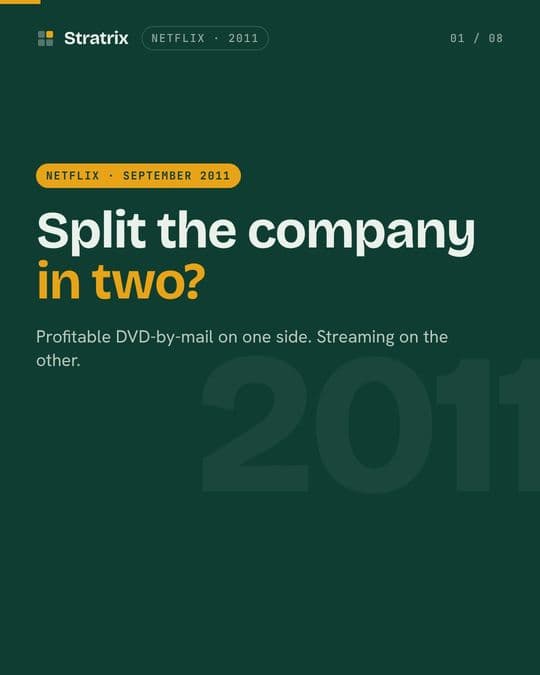
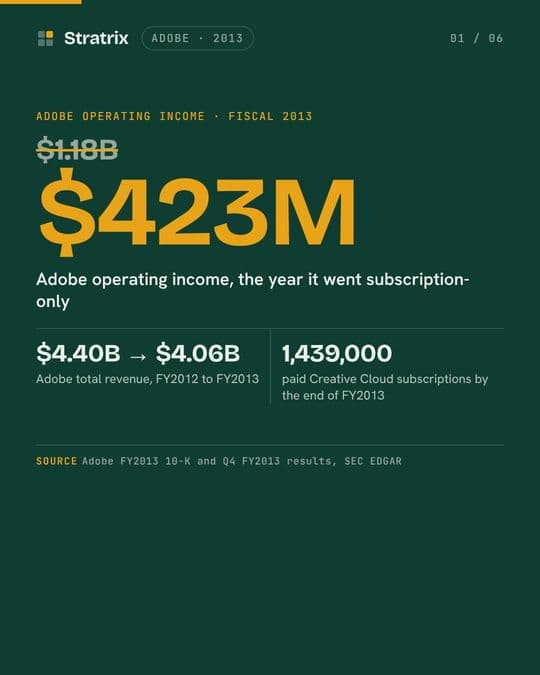
Short videos on companies that faced it, built from the casebooks this pack draws on.

Questions about the Exit Strategy Pack
- What number does the model produce?
- Four. What the business burns a year and that figure at your own multiple; what leaving costs today, and how many years of patience that buys; what the same exit costs at the end of your own estimate; and the difference between the two, which is the price of the delay. The Model tab sweeps candidate years to breakeven rather than prices, so the answer is a column you can point at — and the useful question about that column is how many years your own estimate has already been the same number.
- Isn't this just an argument for cutting things?
- No. Only one of the four readings says to leave. One of the others, where re-entry would cost several times what a buyer would pay, is the strongest argument for staying that most companies never put on the page, and the model produces it as readily as the other three.
- What if the business makes money?
- Then leaving it is a positioning decision rather than a financial one, the model says so explicitly, and it does not halt. It still tells you what leaving would cost and what being back in would cost, which are both worth knowing before the argument rather than during it.
- Are the case studies real companies?
- Yes. Nine sourced exits: GM and Cruise, IBM, HSBC, Uber ATG, Lyft, Goldman Sachs, AT&T, BP, and CVS. Each is dated, read through what the business was, what actually triggered the decision and what leaving cost, and each states what its evidence does not establish. No disclosure separates the effect of an exit from everything else moving in the same period, and none of the figures is presented as doing so. The worked model, wizard, and worksheet use an explicitly fictional business, labeled as such on every file.
- We are not planning to leave. Is this still useful?
- Yes, and arguably more so. A decision to keep a business, taken without the exit price, is not a decision — it is a status quo being described. Pricing it while the business is merely disappointing costs two weeks; pricing it in the quarter the losses become undefendable costs the difference between a sale and a wind-down.
- Is this a subscription?
- No. One payment, one download, sixteen files, yours to keep and to use inside your organization under the license included in the pack.
- What is the Exit Strategy Pack?
- The Exit Strategy Pack is a decision-support kit for one question: What would it cost to leave, and what does waiting cost if you leave anyway? It contains 16 files — foundations, concept deck, decision wizard, exit model, strategies and tactics, case studies, fit worksheet, roadmap template, practitioner manual, field checklist, about the package — built around a single organizing test: every company has a written case for entering a business and none for leaving one, so exits happen by exhaustion rather than by decision — and the cost of leaving grows every year the decision is not taken. It is what a leadership team uses to run the decision and leave a record of what they assumed, rather than a report about the topic.
- Who is the Exit Strategy Pack for?
- Anyone who has to make this call and answer for it: an operator or owner facing the decision, the executive team running it, the board or investor testing the reasoning, or an adviser who would otherwise build the framework from a blank page. It is worth buying when a real decision is in front of you. It is not worth buying to read.
- What is in the Exit Strategy Pack?
- 16 files in Word, PDF, PowerPoint and Excel: Foundations (Word + PDF) — The framework: the asymmetry, the burn, what leaving costs, the price of the delay, and the four halts. Concept deck (PowerPoint + PDF) — Twenty-two slides for a board or portfolio session, with nine sourced exits and what each does not establish. Decision wizard (Excel) — Eight scored questions returning the band, the weakest answer, and either of the two halt conditions. Exit model (Excel, blank and worked) — Eleven candidate years to breakeven across the columns, the cost of leaving in each of them, and the price of the delay. Strategies and tactics (Word) — The moves at each of the four positions, what to do when the model halts, and four ways to make the next exit cheaper to decide. Case studies (Word) — Nine sourced exits — one that took forty years, one that cost $400 million to hand a division away, one company that did the same trade twice. Fit worksheet (Word, blank and worked) — The single page of record: the burn, the exit price, the buyer, the price of the delay and the date. Roadmap template (Word) — Five phases with gates and owners, the assumptions register, a trigger and a periodic reporting line. Practitioner manual (Word + PDF) — Adding the capital to the loss, pricing the exit, the estimate's history, the board paper, six failure modes and their indicators. Field checklist (PDF) — The one-pager that survives outside the binder. About the package (PDF) — What each file does and the order in which to run them.
- How is the Exit Strategy Pack delivered?
- As a single download of all 16 files, immediately after payment, with the same link sent by email. It can be downloaded 3 times and the link is valid for 30 days. There is nothing to install and no account to keep.