Core insight
An entrant's money can take only as many of your customers as it can afford at what taking one costs it. Every response, whether holding, answering, buying or arriving first, is priced against that number rather than against the product.
Why a new competitor is not sized by its product
A new entrant arrives as a product, so the room prices the product. It has a valuation, a press cycle and a demo, and within a week somebody has proposed an answer as a necessity.
What no one has is the two figures that would size the threat, and both are facts about the entrant's business rather than yours: what it costs the entrant to take one of your customers, and how much money it has for this market. The first is readable from its price list, its incentives and its sales hiring. The second is its rounds added up.
How many of your customers can the entrant's money take, at what taking one costs it, and does answering cost less than losing them?
The division, the annuity and the four readings
Divide the entrant's money by what taking one customer costs it, and cap the result at the customers its offer reaches. That is what the money can take. Multiply it by what one of those customers earns you a year over the horizon, and you have what holding costs.
Answering costs something on every customer the entrant reaches, including the ones who were never leaving, plus what it costs once. The decision reduces to the break-even funding: how much money the entrant would need before answering costs less than holding. It is a distance in somebody else's money, read against the last round and watched at the next.
| The reading | What is true | The response |
|---|---|---|
| The money runs out first | The entrant can afford fewer of your customers than its offer reaches. | Hold, and watch the next round rather than the demo. |
| Answering costs less | What the answer costs on every reached customer is less than what holding loses. | Answer, on price or product, costed on the whole base. |
| The money is not the constraint | The entrant can afford every customer it reaches, usually because a parent funds it. | The question becomes the product. Answer where the answer costs less than the segment earns. |
| Buying it is cheaper | Owning the entrant costs less than holding or answering. | Buy, before the next round reprices it. |
| Arriving first | The entrant has not arrived yet. | Occupy the position before somebody funds it. |
The division, in the pack's worked case
The pack's worked example uses a fictional maker of software for 24,000 auto-repair shops, facing an entrant with $140m selling at half its price. Taking a shop costs the entrant about $22,700, so its money can take 6,167 shops, a quarter of the base, worth $139.1m over five years. Matching would cost $460.1m, paid across all 24,000 shops, including the 17,800 who were never leaving. The entrant would need $462.9m before matching paid, and a $55.3m feature build beats the same loss by $83.8m.
Answering, when the incumbent can keep paying
Meta answered TikTok inside its own apps. Meta launched Instagram Reels on August 5, 2020, and in its third-quarter 2022 call said Reels was "negative overall to revenue by about $500 million in the quarter." Meta kept paying: Reels reached more than half of Instagram time spent by January 2025.
Microsoft answered Slack with its bundle. Microsoft unveiled Teams to Office 365 users in 181 countries on November 2, 2016 and included it at no extra cost, and Slack replied with an open letter on a page of The New York Times. Teams passed Slack in daily active users around July 2019 with 13 million, while Slack crossed 12 million only in September. The bundle had a price of its own: in June 2024 the European Commission sent Microsoft a Statement of Objections over the tying, and in September 2025 Microsoft agreed to unbundle Teams for seven years.
Google treated AI answer engines as a feature it could add to search. Google's AI Overviews reached all U.S. users on May 14, 2024, and more than 100 countries and over a billion monthly users by October 2024, and Google began placing ads inside them. Google's search revenue grew 13% to $198.1 billion in 2024, though organic click-throughs reportedly fell about 30% after the launch.
All three priced the answer across every customer the entrant could reach, not only the ones at risk, and all three had the money to keep paying it. None of these records states what taking one customer cost the entrant, which is the figure the method needs and the one most incumbents never assemble.
Answered, then reversed
Blockbuster answered Netflix on the grievance Netflix sold against: late fees. In 2000 late fees were nearly $800 million, about 16% of Blockbuster's revenue. In December 2004 Blockbuster announced the end of late fees from January 1, 2005 across more than 4,500 U.S. stores, paired with a push into online DVD subscriptions.
Matching Netflix meant deleting one dollar in six off the top, and the board would not keep paying it. Carl Icahn, with a stake of nearly 10% and three board seats, opposed both the late-fee elimination and the online expansion. Blockbuster announced John Antioco's departure on March 21, 2007 after a bonus dispute with the Icahn-led board, reinstated late fees in 2010, and filed for Chapter 11 on September 23, 2010.
Coca-Cola answered the Pepsi Challenge by changing the product. After roughly 190,000 blind taste tests, Coca-Cola replaced its formula with a sweeter one on April 23, 1985. Calls to Coca-Cola's hotline reached some 8,000 a day by June, and on July 11, 1985, 79 days after the launch, Coca-Cola brought back the original as Coca-Cola Classic.
Both answers were aimed at what the challenger made visible. Blockbuster's answer was, on its record, its best shot, and the people funding it stopped. An answer is only as good as the willingness to keep paying for it, so cost it for the full horizon before you start.
When the entrant's money is not the constraint
Some entrants are funded by a parent, and dividing their money by anything returns more customers than the offer reaches. Then the question is the product, and in the two cases below, holding lost the base.
eBay held 85% of China's C2C market through EachNet, which it bought in 2003. Alibaba launched Taobao that year as a separate business unit, with free listings against eBay's fee-based model and Alipay escrow to address the trust deficit in Chinese e-commerce. By 2006 eBay had shut its standalone China operations and entered a joint venture with Tom Online. Alibaba's China retail marketplaces handled US$248 billion of gross merchandise volume in the twelve months to December 2013.
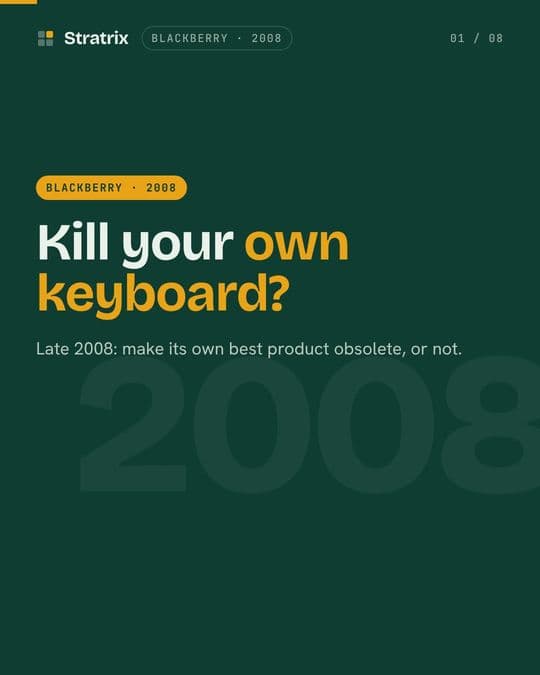
BlackBerry held against the iPhone. Its touchscreen answer, the Storm, launched in late 2008 as a hedge that kept a keyboard's click-feel, and Verizon had to replace almost all of the roughly one million units shipped. BlackBerry's revenue kept climbing to $19.9 billion in fiscal 2011, up 33%, while its global smartphone share fell for seventeen consecutive quarters, from about 20% to 0.5% by early 2014. Rising revenue while the base moves is what holding looks like from inside.
Buying it, outlasting it, or arriving first
Facebook bought Instagram for approximately $1 billion in cash and shares, announced April 9, 2012. Zuckerberg wrote beforehand that "what we're really buying is time." By 2025 Instagram was estimated to account for roughly half of Meta's U.S. advertising revenue.
Facebook agreed on February 19, 2014 to buy WhatsApp for about $16 billion in cash and stock plus $3 billion in restricted stock units, when WhatsApp had more than 450 million monthly users. Google had reportedly offered $10 billion, and keeping WhatsApp from Google was as much the point as owning it.
Quibi is the entrant whose money ran out first. Quibi launched on April 6, 2020, charging a subscription for short video against TikTok and YouTube, which charged nothing, and spent more than $1 billion commissioning 8,500 episodes. Quibi announced its shutdown on October 21, 2020, and its library was sold to Roku in January 2021 for "significantly less than $100 million." For an incumbent that is the first reading: the money runs out before it can take the base.
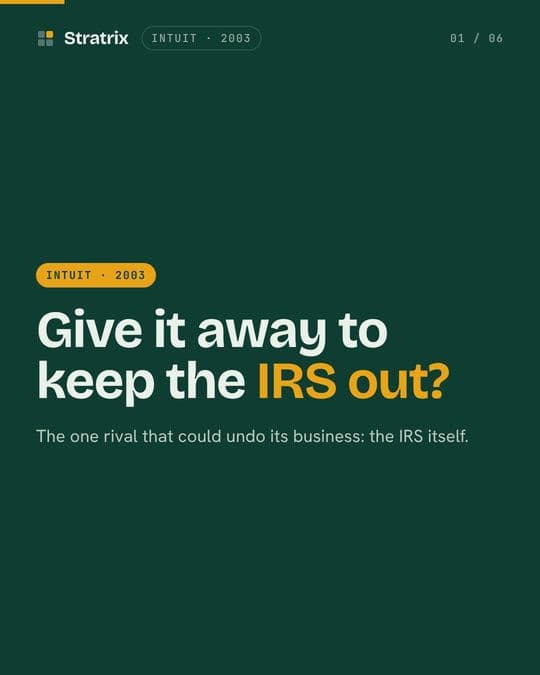
The fifth response is arriving first. Intuit joined the Free File Alliance formed in 2003, under which the IRS agreed not to offer a duplicative or competing service as long as the industry offered free filing. Intuit has spent $53.8 million on federal lobbying since 2004, the IRS's Direct File program was ended in 2025, and Intuit's Consumer Group revenue grew to $4.9 billion in fiscal 2025.
What these cases show
Each case is drawn from the Stratrix case library and checked against the filings and reporting listed under Sources. The last column says what each one does not establish.
| Company | Reading | What happened | What it does not establish |
|---|---|---|---|
| Meta, 2020 | Answered | Meta's Reels cost about $500 million of revenue in a quarter and passed half of Instagram time by January 2025 | What taking one user cost TikTok |
| Microsoft, 2016 | Answered with the bundle | Microsoft's Teams passed Slack in daily users by July 2019; Microsoft later agreed to unbundle it for seven years | How much of the lead came from the bundle rather than the product |
| Google, 2024 | Answered by absorbing | Google's search revenue grew 13% to $198.1 billion in 2024 | Whether the fall in organic click-throughs costs Google later |
| Blockbuster, 2004 | Answered, then reversed | Blockbuster ended late fees, about 16% of its revenue in 2000; the CEO funding it left; Chapter 11 in 2010 | That the answer would have worked if the board had kept funding it |
| Coca-Cola, 1985 | Answered, then reversed | Coca-Cola brought the original formula back 79 days after replacing it | That the reversal, rather than the brand, restored the lead |
| eBay in China, 2003 | Held against a parent-funded entrant | eBay held 85% of China's C2C market through EachNet and shut its standalone China operations by 2006 | How much of the loss was the fee model rather than trust |
| BlackBerry, 2008 | Held against an entrant whose money was not the limit | BlackBerry's revenue rose to $19.9 billion in fiscal 2011 while its smartphone share fell to 0.5% by early 2014 | What a full answer in 2008 would have cost |
| Facebook, 2012 and 2014 | Bought | Facebook paid about $1 billion for Instagram, and about $16 billion plus $3 billion in units for WhatsApp | That buying was cheaper than answering would have been |
| Quibi, 2020 | The entrant's money ran out first | Quibi spent more than $1 billion on content and announced its shutdown in October 2020 | What, if anything, holding cost the incumbents |
| Intuit, 2003 | Arrived first | Under Free File the IRS agreed not to offer a competing service; Intuit has spent $53.8 million on lobbying since 2004 | Whether the arrangement held because of the lobbying |
Running the decision
A sequence for the team facing a funded entrant
Count the reach
The customers the entrant's offer actually reaches: the segments its price, product and channel can serve.
Find what one costs the entrant to take
What it spends winning a customer, plus what it gives up on that customer a year against your price, for as long as it can hold that price. Its price list, incentives and sales hiring carry it.
Add up its money
Its rounds, or what a parent has committed to your market. If you cannot establish this figure or the one before it, stop: those are the two halts.
Divide, then price holding
Money divided by the cost to take, capped at the reach, times what one of those customers earns you over the horizon.
Price answering on the whole base
What the answer costs on every customer the entrant reaches, including those who were never leaving, plus what it costs once. Price the cheaper answers too, such as a feature build.
Read the break-even funding and set the watch
How much money the entrant would need before answering costs less than holding. Read it against the last round and check it again at the next one.
What this method cannot tell you
The evidence runs the other way from most decisions. The cases carry what answers cost and what holding cost, and almost nothing on what an entrant paid per customer taken, so the cost to take is the method's own analysis rather than something the cases prove.
The arithmetic also simplifies. It treats taken customers as gone for the whole horizon, which overstates what holding costs. It treats a full answer as keeping every customer the entrant reaches, and does not price what the entrant's product then wins on its own. And it holds the cost to take flat as the entrant grows, which is why it should be swept across a range rather than settled. The cases support recognizing the readings. They cannot support a rate, and this page does not claim one.
Watch these decisions
Short videos built from the same Decision Records as this page.
Questions
How should you respond to a new competitor?
Size it by its money before its product. Divide what the entrant has for your market by what it costs it to take one of your customers, price what those customers would have earned you, and compare that with what answering costs on every customer the entrant reaches.
Should you match a new entrant's price?
Not because it is funded. In the pack's worked example, which uses a fictional company, matching would cost $460.1m across the whole base, against $139.1m of contribution the entrant's money could take.
When should an incumbent buy a new competitor?
When owning it costs less than either holding or answering. Facebook bought Instagram for about $1 billion in 2012 and agreed to buy WhatsApp for about $16 billion plus $3 billion in units in 2014.
What if the new competitor is backed by a large parent company?
Then its money is not the constraint, and the question becomes the product. BlackBerry held against the iPhone while its revenue kept rising, and its global smartphone share fell from about 20% to 0.5% by early 2014.
What is break-even funding?
The money an entrant would need before answering it costs less than holding. It is a distance in somebody else's money, read against the entrant's last round and watched at the next.
Continue learning
Sources & further reading
- Instagram (Meta) (2020). Introducing Instagram Reels: Short Video for Everyone.
- Meta Platforms, Inc. (2022). Meta Q3 2022 Earnings Call Transcript.
- TechCrunch (2022). Meta says Reels now makes up over 20% of the time users spend on Instagram.
- BleepingComputer (2016). Microsoft Launches Teams, as Slack Fires Warning Shot via New York Times Back Page Ad.
- Statista / BleepingComputer (2019). Chart: Microsoft Teams Powers Past Slack.
- European Commission (2024). Commission sends Statement of Objections to Microsoft over possibly abusive tying practices regarding Teams.
- Courthouse News Service (2025). Microsoft sidesteps billions in EU fines with Teams unbundling deal.
- Alphabet Inc. / SEC EDGAR (2025). Alphabet Inc. Form 10-K, Fiscal Year Ended December 31, 2024.
- Google / blog.google (2024). New generative AI experiences in Google Search.
- Google / blog.google (2024). AI Overviews in Google Search expanding to more than 100 countries.
- SQ Magazine (citing BrightEdge and Seer Interactive studies) (2026). AI Overviews Statistics 2026: Google Search Impact Data.
- NBC News / Associated Press (2010). Hubris, and late fees, doomed Blockbuster.
- SEC EDGAR / Blockbuster Inc. (2004). Form 8-K Exhibit 99.1: Blockbuster Announces the End of Late Fees.
- CNBC (2020). Netflix didn't kill Blockbuster: how Netflix almost lost the movie rental wars.
- The Hollywood Reporter / Associated Press (2007). Antioco stepping down from Blockbuster post.
- U.S. Securities and Exchange Commission / Blockbuster Inc. (2010). Blockbuster Inc. Form 8-K (Bankruptcy Filing Disclosure).
- HISTORY.com (1985). New Coke debuts, one of the biggest product flops in history.
- HISTORY.com (2023). Why Coca-Cola's 'New Coke' Flopped.
- INSEAD Knowledge (2022). What the War Between Alibaba and Tencent Says About Strategy.
- IMD Business School (2022). Alibaba vs. eBay: Competing in the Chinese C2C market.
- U.S. Securities and Exchange Commission (2014). Alibaba Group Holding Limited Form F-1 Registration Statement.
- Wikipedia / Losing the Signal (McNish & Silcoff, 2015) (2015). BlackBerry Storm.
- Research In Motion Limited / GlobeNewswire (2011). Research In Motion Reports Year-End and Fourth Quarter Results for Fiscal 2011.
- Gartner / Statista (2016). Global smartphone OS market share held by RIM (BlackBerry) from 2007 to 2016, by quarter.
- Meta (Facebook Newsroom) (2012). Facebook to Acquire Instagram.
- TechCrunch (2025). Read what Mark Zuckerberg and Facebook execs said about Instagram before buying it.
- CNBC (2025). Meta wins FTC antitrust trial that focused on WhatsApp, Instagram.
- U.S. Securities and Exchange Commission / Facebook, Inc. (2014). Form 8-K Exhibit 99.1: Facebook to Acquire WhatsApp.
- Meta (Facebook) Newsroom (2014). Facebook to Acquire WhatsApp.
- Time / Business (2014). Google Made Bid for WhatsApp Before Facebook Purchased.
- CNBC (2020). Quibi officially announces it's shutting down.
- Variety (2021). Roku Acquires Global Rights to 75-Plus Quibi Shows, Will Stream Them for Free.
- Intuit Inc. / SEC EDGAR (2019). Form 10-K for Fiscal Year Ended July 31, 2019.
- OpenSecrets (2026). Tax prep companies set lobbying record as IRS Direct File ended.
- Intuit Inc. Investor Relations (2025). Intuit Reports Strong Fourth Quarter and Full Year Fiscal 2025 Results.
More to learn
Other foundational guides worth reading.
Post-Merger Integration: How to Tell Whether the Deal Is Paying for Itself
A synergy reported and a synergy in the ledger are different findings. An integration is working only when the promise reaches the accounts, net of the revenue the combination cost, before the year it stops paying for the premium.
Pricing StrategyFree Tier Strategy: When Does Freemium Pay for Itself?
A free tier pays for itself when the share of free users who start paying each year clears the break-even conversion rate: what one free user costs a year, net of what they earn, divided by what one conversion is worth. The paying-over-total ratio in most decks is not that rate, and some free tiers are paid for by another side of the market or by a layer sold on top, not by converts.
Growth & ExpansionExpansion Plan: How Fast Can a Rollout Actually Go?
Plans express themselves as destinations: two hundred stores, twelve countries. A destination cannot be wrong, only late. A rate can be checked, and most expansions fail because the rate was faster than the operation behind it could carry.
Growth StrategyProduct Cannibalization: When to Launch the Product That Eats Yours
A cannibalization decision holds two questions. Whether the substitution happens is a question about your customers, answered outside your building. Whether you should supply it is arithmetic: the share of switching customers you must win, set beside the best share your company has ever won.
Crisis ManagementCorporate Crisis Response: What One More Quarter of Delay Costs
A corporate crisis is priced on the gap between when somebody inside knew and when the company acted, not on the defect itself. Find the earliest internal date, cost what one more quarter of delay adds, and act before the expected penalty passes the cost of the fix.
M&ASerial Acquisition Strategy: How to Price the Growth You Buy
A serial acquirer's engine is the gap between what the market pays for its earnings and what it pays for somebody else's. Split the plan's growth into the part you will grow and the part you must buy, price each deal as a multiple of the earnings it brings, compare that with buying back your own shares, and state the year the balance sheet stops funding it.
See this framework in the wild.
Follow it across the companies and lenses where it actually shaped the strategy.