Core insight
A crisis runs on two clocks: the news cycle, which runs in hours, and the gap between knowing and acting, which runs in quarters. Regulators, courts and juries price the second one, and it is measured from a document the company already holds.
Why a crisis response is designed on the wrong clock
Every crisis playbook addresses the news cycle, because the news cycle is what everybody can see. It runs in hours. The clock that decides the bill runs in quarters, starts at a document inside your own company, and is usually already running when the war room convenes.
So the room argues about the statement and the remediation budget. Both matter less than they feel. The question that sets the cost is how long the company has known, and what each further quarter of not acting adds.
What is one more quarter of not acting worth, measured from the first date somebody inside the company knew?
The four costs, and which of them grow
| The cost | What it is | What the gap does to it |
|---|---|---|
| Remediation | A fixed program cost plus a cost per affected unit. | Nothing. It is the only one that does not move, and the only one being argued about. |
| The penalty | What an authority imposes, times the chance one is imposed. | It scales with the interval rather than with the harm. |
| The exposed population | Everything in the field, plus everything shipped while unresolved. | It grows every quarter, and that growth is entirely within your control. |
| The revenue step-down | Customers who buy less once they learn how long it was known. | It deepens with the gap, and a share of it never comes back. |
Remediation is the figure the room argues about, and it is the only one of the four that delay does not move. The other three grow with the gap. At some quarter the expected penalty passes what the fix would have cost. That quarter is the crossing, and after it the argument that the fix is too expensive is no longer true on the company's own arithmetic.
Find the date: the gap starts at a document you already hold
Toyota's sticky-pedal case shows where the date sits. The Justice Department's statement of facts says Toyota was investigating the pedal in the U.S. by August 2009 and reproduced the problem by September 2009, then told regulators and Congress it first learned of it in October 2009.
Toyota's false date was built to make a 90-day reporting window appear to have been met. NHTSA demanded the maximum $16.375 million civil penalty from Toyota in April 2010 for more than four months of failure to notify, and in March 2014 Toyota agreed to a $1.2 billion penalty under a Deferred Prosecution Agreement.
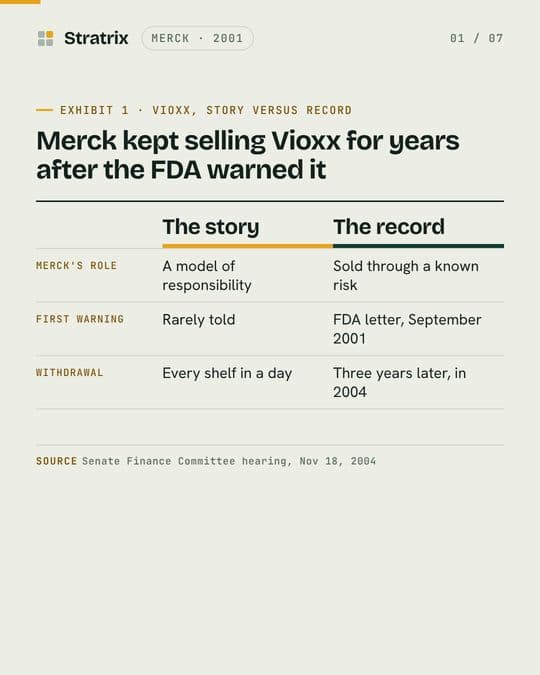
Merck's date was a letter. In September 2001 the FDA sent Merck a warning letter about promotion that discounted the cardiovascular findings of its VIGOR study of Vioxx. Merck changed the label in April 2002 and kept selling, then withdrew Vioxx worldwide on September 30, 2004, after more than 80 million people had taken it.
Merck's bill came afterward: a fixed $4.85 billion fund for heart-attack and stroke claims in 2007, $950 million to resolve Justice Department marketing allegations in 2011, and $830 million to settle an investor class action in 2016.
Facebook's date was two years old when it mattered. The SEC alleged that Facebook had known for two years that Cambridge Analytica had misused the data of roughly 57 million users, while its filings told investors that user data "may be" improperly accessed. In July 2019 the FTC fined Facebook $5 billion and the SEC added $100 million.
A warning letter, a test result, an engineer's email, an internal finding that was filed and not escalated. Commission the search to find the earliest record, not the most defensible one. If nobody can establish the date, stop: that is the first of the two halts, and no cost of delay can be computed without it.
Three breaches, three intervals
The penalty scales with the interval rather than with the harm, and a data breach is where the interval is easiest to see, because the discovery date is usually on record. Three breaches show three different intervals between knowing and telling.
Uber learned of a breach in November 2016, paid the hackers $100,000 to delete what they had taken, and dressed the payment up as a routine bug-bounty reward. Uber disclosed the breach a full year later, in November 2017. In September 2018 Uber agreed to pay a record $148 million to settle with all 50 states and the District of Columbia, and in May 2023 Uber's former security chief was sentenced to three years' probation and a $50,000 fine.
Equifax found its breach on July 29, 2017 and told the public 40 days later, on September 7, after it had worked out what had happened. Equifax's chief executive retired that month, and in July 2019 Equifax entered a global settlement with the CFPB, the FTC and 48 states providing up to $700 million.
Capital One confirmed its intrusion on July 19, 2019 and announced it on July 29, with roughly 106 million people affected. The $80 million penalty the OCC assessed on Capital One in August 2020 was for risk-governance failures from before the bank moved to the cloud, not for the disclosure.
The amounts are not comparable, and three cases prove nothing about rates. They do show what was examined: in Uber's case the year of concealment itself, and in Capital One's case not the ten-day disclosure but an older governance failure.
The narrow fix: what a quiet settlement buys
3M paid $9.1 million in July 2018 to resolve False Claims Act allegations over its Combat Arms earplugs, with no admission of liability. The settlement carried neither disclosure nor remediation, so it did not close the claims from users. 3M put its Aearo unit into bankruptcy with a proposed $1 billion trust in July 2022, a judge dismissed that case in June 2023 because Aearo was financially healthy, and in August 2023 3M announced a $6.0 billion earplug settlement.
Volkswagen confirmed its diesel defeat device to regulators on September 3, 2015, and its board assessed the fallout as "controllable and comparable to past cases that had been resolved amicably." German prosecutors later alleged that Volkswagen's chief executive had known since May 2015. In January 2017 Volkswagen agreed to plead guilty to three felony counts and pay $4.3 billion to U.S. authorities. By July 2020 Volkswagen had repaid more than $9.5 billion to U.S. car buyers, and more than 86% of claimants chose a buyback or lease termination over a fix. By mid-2020 the scandal had cost Volkswagen more than 30 billion euros, about $33 billion.
One more quarter, in the pack's worked case
The pack's worked example uses a fictional company. The gap is three quarters. Remediation has been costed at $117.7m against a figure of about $95m the room had been repeating, and one more quarter of delay costs $72.5m. The crossing is one quarter away, which makes this the last quarter in which the argument that the fix is too expensive is arithmetically true.
Nothing in that tells the company what to disclose. It tells the company what the deferral costs, which it did not know, and it puts that figure beside the remediation number the room has been repeating.
The second halt: answering the reaction instead of the substance
The second way a response fails is by treating the coverage as the crisis. It shapes a statement, contests a number or defends a procedure, and leaves the substance where it was.
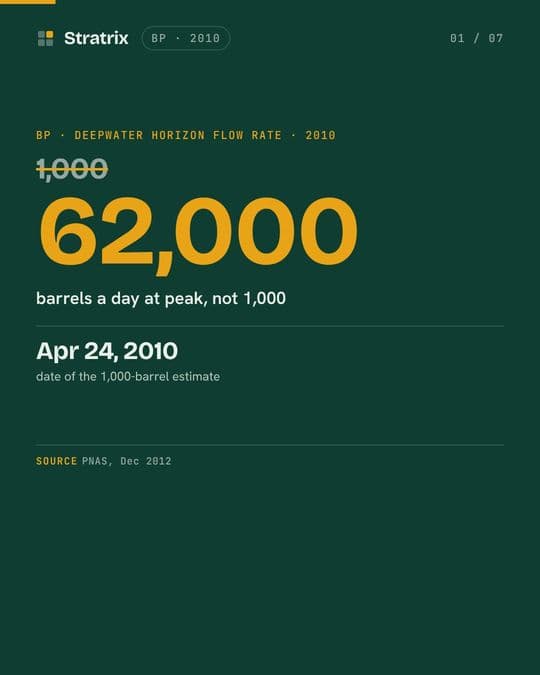
In April 2010 the U.S. Coast Guard, in consultation with BP, told the public that the Deepwater Horizon well was leaking around 1,000 barrels a day. The government's Flow Rate Technical Group later put BP's peak flow at roughly 62,000 barrels a day. In November 2012 BP pleaded guilty to 11 felony manslaughter counts and obstruction of Congress and agreed to about $4.5 billion in criminal penalties, and in April 2016 a judge approved a $20.8 billion civil settlement with BP.
United's first statement after a passenger was dragged off Flight 3411 apologized for having to "re-accommodate these customers" and called the episode upsetting. A fuller apology came the next day. United shares fell as much as 4.3% on April 11, 2017, and on April 27 United announced ten policy changes, including raising maximum compensation for an involuntary bump to $10,000.
Samsung announced a global recall of the Galaxy Note 7 on September 2, 2016 without first notifying the CPSC, and its mobile chief described the cause as "a tiny problem in the manufacturing process." Overheating reports followed in the replacement phones, and by October 13 the CPSC had expanded the Samsung recall to roughly 1.9 million U.S. devices. By mid-January 2017 Samsung reported that 97% of Note 7s had been returned in the U.S.
Norsk Hydro is the short-gap case. Hit by ransomware on March 19, 2019, Norsk Hydro isolated its plants, said the same day what had happened, refused to pay the ransom and held daily press conferences. Norsk Hydro's estimate of the first-half cost still rose from $41m to roughly $64-75m. A short gap does not make a crisis cheap; it keeps the interval out of the bill.
If the response plan is a statement, a hotline and a media list, and nothing in it changes the product, the figure or the process the crisis is about, it addresses the reaction rather than the substance. Stop and redesign it before it ships.
What these cases show
Each case is drawn from the Stratrix case library and checked against the filings and reporting listed under Sources. The last column says what each one does not establish.
| Company | The date somebody knew | What followed | What it does not establish |
|---|---|---|---|
| Toyota, 2009 | Pedal problem reproduced by September 2009; regulators told October 2009 | Toyota paid a $16.375 million civil penalty in 2010 and a $1.2 billion criminal penalty in 2014 | How much of the penalty the false timeline added rather than the defect |
| Merck, 2001 | FDA warning letter in September 2001; Vioxx withdrawn in September 2004 | Merck set up a $4.85 billion liability fund, then paid $950 million and $830 million in later settlements | That an earlier withdrawal would have avoided those costs |
| Facebook, 2018 | Cambridge Analytica misuse known for two years before the filings called it a risk | Facebook was fined $5 billion by the FTC and $100 million by the SEC in 2019 | What disclosure at the time would have cost instead |
| Uber, 2016 | Breach known November 2016; disclosed November 2017 | Uber paid $148 million to all 50 states and DC; its security chief was convicted | What prompt disclosure would have cost |
| Equifax, 2017 | Breach found July 29; disclosed September 7 | Equifax settled for up to $700 million in 2019; its chief executive retired | How much of the settlement the 40 days drove rather than the breach |
| Capital One, 2019 | Intrusion confirmed July 19; disclosed July 29 | Capital One paid an $80 million OCC penalty for older governance failures | That fast disclosure lowers penalties in general |
| 3M, 2018 | Earplug allegations settled for $9.1 million, nothing disclosed | 3M announced a $6.0 billion earplug settlement in 2023 | That disclosure in 2018 would have cost less |
| Volkswagen, 2015 | Chief executive alleged to have known by May 2015 | Volkswagen paid $4.3 billion to U.S. authorities; the total passed 30 billion euros by 2020 | When the board, rather than its engineers, first knew |
| BP, 2010 | Flow stated at 1,000 barrels a day; peak later put at 62,000 | BP paid about $4.5 billion in criminal penalties; a $20.8 billion civil settlement followed | How much of the cost the understatement added |
| United, 2017 | First statement within a day | United shares fell as much as 4.3% intraday; ten policy changes followed | Any lasting cost; the DOT found enforcement action not warranted |
| Samsung, 2016 | Recall announced without the regulator | Samsung's recall widened to about 1.9 million U.S. devices; 97% were returned by January 2017 | That working through the CPSC first would have been faster |
| Norsk Hydro, 2019 | Disclosed the day of the attack | Norsk Hydro estimated a first-half cost of roughly $64-75m | That openness lowered the cost of recovery |
Running the decision
A sequence for the team that has found something
Find the date
Search your own records for the earliest document showing somebody inside knew: a test, a letter, an email, a filed finding. Without it, stop.
Cost the four costs
Remediation on the population exposed by each quarter, the expected penalty at the gap by then, the revenue step-down, and the share of it that never comes back.
Price one more quarter
The difference between acting this quarter and next. Put it in the board paper beside the remediation figure the room has been repeating.
Locate the crossing
The quarter in which the expected penalty passes the cost of the fix. After it, the fix is the cheaper option on your own arithmetic.
Test the response against the substance
For each part of the plan, name what it changes in the product, the figure or the process. A part that changes only the coverage is the second halt.
Hand the legal question to counsel
What you must report, to whom and by when differs by jurisdiction and regulator. This method prices the interval; it does not set the obligation.
What this method cannot tell you
The case set is selected on enforcement rather than on conduct. These intervals are documented because a regulator, a prosecutor or a court compelled the file, and the companies that closed a gap quietly and early leave no record. The cases support recognizing a mechanism. They cannot support a rate, and this page claims no probability of enforcement and no penalty multiplier.
It also cannot tell you what you are obliged to disclose. That is a legal question with a legal answer. What the method gives you is the cost of the interval, in a form a board can act on while the interval is still open.
Watch these decisions
Short videos built from the same Decision Records as this page.
Questions
How should a company respond to a corporate crisis?
Start with the date somebody inside first knew, not with the statement. Cost what one more quarter of not acting adds in penalty, exposed population and lost revenue, set it beside the cost of the fix, and make sure the response changes the substance rather than only the coverage.
What does delaying disclosure cost?
It grows with the interval. Remediation does not move, but the expected penalty, the exposed population and the revenue step-down rise each quarter the gap stays open. Toyota's falsified timeline ended in a $1.2 billion criminal penalty in 2014.
How fast should a company disclose a data breach?
The legal deadline depends on the jurisdiction and the regulator, so ask counsel. The cases show the range: Capital One announced its breach ten days after confirming it, Equifax 40 days after finding its breach, and Uber a full year after paying the hackers.
What is the crossing in a crisis?
The quarter in which the expected penalty for delay passes what the fix would have cost. Before it, deferring can be argued on cost. After it, the deferral is the expensive option.
Is a fast apology enough?
No. An apology addresses the reaction. United's first statement about Flight 3411 had to be corrected with a fuller apology the next day, and what followed were ten policy changes, including raising maximum compensation for an involuntary bump to $10,000.
Continue learning
Sources & further reading
- U.S. Department of Justice / SDNY (2014). Statement of Facts, United States v. Toyota Motor Corporation.
- U.S. Department of Justice, Office of Public Affairs (2014). Justice Department Announces Criminal Charge Against Toyota Motor Corporation and Deferred Prosecution Agreement with $1.2 Billion Financial Penalty.
- U.S. Department of Transportation / NHTSA (2011). Results From NHTSA-NASA Study Of Unintended Acceleration In Toyota Vehicles.
- U.S. Senate Finance Committee / Government Publishing Office (2004). FDA, Merck and Vioxx: Putting Patient Safety First?.
- U.S. Department of Veterans Affairs / Merck (2004). Merck Announces Voluntary Worldwide Withdrawal of VIOXX.
- U.S. Securities and Exchange Commission / Merck & Co., Inc. (2007). Form 8-K, Merck Agreement to Resolve U.S. VIOXX Product Liability Lawsuits.
- Fierce Pharma (2016). Merck reaches $830M settlement in long-running Vioxx litigation.
- Federal Trade Commission (2019). FTC Imposes $5 Billion Penalty and Sweeping New Privacy Restrictions on Facebook.
- Ropes & Gray LLP (citing SEC settlement announcement) (2019). FTC Imposes Record-Setting $5 Billion Penalty to Resolve Allegations that Facebook Violated User Data Privacy.
- TechCrunch (2017). Uber data breach from 2016 affected 57 million riders and drivers.
- Office of the New York Attorney General (2018). A.G. Underwood Announces Record $148 Million Settlement With Uber Over 2016 Data Breach.
- U.S. Attorney's Office, Northern District of California (DOJ) (2023). Former Chief Security Officer Of Uber Sentenced To Three Years' Probation For Covering Up Data Breach.
- U.S. Securities and Exchange Commission (EDGAR) (2017). Equifax Inc. Form 8-K, Item 8.01, dated September 7, 2017.
- Consumer Financial Protection Bureau (2019). Equifax, Inc. Enforcement Action Summary.
- Capital One Financial Corp. (2019). Exhibit 99.1 Press Release, Form 8-K.
- Office of the Comptroller of the Currency (2020). OCC Assesses $80 Million Civil Money Penalty Against Capital One.
- U.S. Department of Justice, District of South Carolina (2018). 3M Company Agrees to Pay $9.1 Million to Resolve Allegations that It Supplied the United States with Defective Dual-Ended Combat Arms Earplugs.
- Bloomberg Law (2023). 3M Earplug Unit Aearo Technologies Tossed Out of Bankruptcy.
- 3M Company (SEC Form 8-K Exhibit 99.1) (2023). 3M Announces Combat Arms Settlement.
- Volkswagen AG (2015). Volkswagen Group Annual Report 2015: The Emissions Issue.
- U.S. Department of Justice / Eastern District of Michigan (2017). Volkswagen AG Agrees to Plead Guilty & Pay $4.3 Billion in Criminal & Civil Penalties.
- Federal Trade Commission (2020). In Final Court Summary, FTC Reports Volkswagen Repaid More Than $9.5 Billion To Car Buyers.
- CNN Business (2021). Volkswagen's ex-CEO pays company $14 million over his role in the diesel scandal.
- France24 (2020). Volkswagen bosses avoid trial over 'Dieselgate' with €9m settlement.
- Proceedings of the National Academy of Sciences (PNAS) (2012). Review of flow rate estimates of the Deepwater Horizon oil spill.
- U.S. Department of Justice (2015). U.S. and Five Gulf States Reach Historic Settlement with BP to Resolve Civil Lawsuit Over Deepwater Horizon Oil Spill.
- U.S. Department of Interior (2016). Historic NRDAR Settlement Reached for Deepwater Horizon Spill.
- CNN Money (2017). Digging itself out of a hole: How United's PR response evolved.
- Yahoo Finance / Myles Udland (2017). United Airlines loses $950 million in market value as shares tumble.
- NPR (2017). United Airlines Settles With Passenger Dragged From Plane.
- U.S. Department of Transportation (2017). DOT Enforcement Letter to United Airlines re: Flight 3411.
- Consumer Reports (2016). Consumer Product Safety Commission Announces Recall of Samsung Galaxy Note7.
- U.S. Consumer Product Safety Commission (2016). Samsung Expands Recall of Galaxy Note7 Smartphones Based on Additional Incidents with Replacement Phones.
- Consumer Reports (2017). Samsung Investigation Reveals New Details About Note7 Battery Failures.
- Norsk Hydro (via GlobeNewswire) (2019). Norsk Hydro: Update: Hydro subject to cyber-attack.
- Microsoft (Source) (2019). Hackers hit Norsk Hydro with ransomware. The company responded with transparency.
- Reinsurance News (2019). Norsk Hydro puts H1 cyber-attack impact at up to $75 million.
More to learn
Other foundational guides worth reading.
Cost Reduction Program: What a Cut Buys and What Reversing It Costs
Every cost cut buys a smaller capability, and only the saving reaches the paper. For each cut, divide what rebuilding the capability would cost by the annual saving to get the reversal price in years, and divide the saving by the profit running through what was cut to see how small a loss would cancel it.
Pricing StrategyPrice Increase Strategy: How Much Volume Can a Rise Afford to Lose?
A price rise is decided by two numbers. The share of volume it can afford to lose is arithmetic on the rise and your contribution margin; the share it will lose comes from measuring your own last rise against the trend before it. Raise as far as the gap between them allows, net of what the field discounts away.
Competitive StrategyHow to Respond to a New Competitor: Price Its Money, Not Its Product
Size a new competitor by its money, not its demo. Divide what it has for your market by what it costs it to take one of your customers, price what those customers would have earned you, and answer only if answering on every customer it reaches costs less than that.
Pricing StrategyProduct Bundling Strategy: When to Sell Together or Apart
A bundle first hands its discount back to every customer already paying for both products, and earns only on the customers it adds and the extra years bundled customers stay. Match the two customer lists to size the handback, measure the retention gap, and solve for the deepest discount at which selling together still beats selling apart.
Growth StrategyProduct Cannibalization: When to Launch the Product That Eats Yours
A cannibalization decision holds two questions. Whether the substitution happens is a question about your customers, answered outside your building. Whether you should supply it is arithmetic: the share of switching customers you must win, set beside the best share your company has ever won.
M&ASerial Acquisition Strategy: How to Price the Growth You Buy
A serial acquirer's engine is the gap between what the market pays for its earnings and what it pays for somebody else's. Split the plan's growth into the part you will grow and the part you must buy, price each deal as a multiple of the earnings it brings, compare that with buying back your own shares, and state the year the balance sheet stops funding it.
See this framework in the wild.
Follow it across the companies and lenses where it actually shaped the strategy.