Core insight
Buying earnings at a lower multiple than the market pays for your own creates value on the day, before integration or synergy, which is why the engine works and why it stops when either multiple moves. The question a serial acquirer rarely answers is not whether the next deal is good but how much of the plan has to be bought, at what multiple, and for how many more years the balance sheet can pay.
Why a growth rate is a purchase order
A plan says profit will grow at some rate. The businesses you already own will produce part of that. The difference has to be bought, with money, from owners who do not have to sell, and the size of that bill is fixed the day the rate is announced, before anyone has looked at a single target.
Almost no acquirer states that bill, because a growth rate does not look like a purchase order. In the worked case used in the Acquisition Machine Strategy Pack, a plan of nine percent growth against three percent organic commits the company to buying $74.4 million of profit a year at a cost of $818.4 million.
What the market pays for a dollar of your earnings, less what you pay for a dollar of somebody else's. Buy a dollar of profit at eleven times and carry it at seventeen, and six times that dollar appears on the day, before integration and before a single synergy.
The four numbers a serial acquirer should be able to state
A serial acquisition strategy reduces to four figures the company already has or can produce in a week. When any one of them is missing, the machine is running on a sentence.
| The number | What it answers | The signal it is missing |
|---|---|---|
| Bought against grown | How much of the plan's growth must be purchased each year, and what that costs at the multiple you have been paying. | Reported growth is presented as one figure, with acquisitions folded in. |
| The multiple paid | What each deal cost per dollar of the earnings it brought, not the transaction value. | Deal papers state an enterprise value and a premium, and no earnings figure beside them. |
| The spread against a buyback | What the same money would have retired of your own earnings if you had bought your own shares instead. | The board paper has no alternative use of the money in it. |
| The year the balance sheet stops | When debt, cash and share issuance can no longer fund the buying the plan requires. | Leverage targets exist, and no one has set them against the plan's purchase bill. |
The spread is settled entirely by whether the multiple you pay sits below the one you trade at. Where your currency is expensive and you buy cheaply, the spread is real money. The two questions it never asks are how long the balance sheet funds it and what happens when your own multiple falls.
What you pay with: shares, cash or debt
Cisco once paid in its own stock. In September 1993 it handed over two million shares, worth about $97 million at that day's close, for Crescendo Communications, because customers wanted switching gear Cisco did not make. Thirty-one years later it closed its largest deal ever in cash: $157 a share for Splunk, about $28 billion, at a 31% premium to Splunk's unaffected price, more than four times the size of Cerent or Scientific Atlanta. The same acquirer moved from paying with a rich currency to paying with the balance sheet.
Exxon paid for Pioneer entirely in its own shares. The agreement signed on October 10, 2023 gave 2.3234 Exxon shares for each Pioneer share, $59.5 billion in equity and about $64.5 billion with debt, at an 18% premium to Pioneer's undisturbed close and only a 9% premium to its prior 30-day average price. Paying in stock shared the commodity risk with Pioneer's holders. Exxon has since raised its annual synergy target from about $2 billion to $4 billion.
Salesforce built its platform the same way, check by check: about $2.5 billion for ExactTarget in 2013, $2.8 billion for Demandware, $6.5 billion for MuleSoft, $15.7 billion for Tableau and $27.7 billion for Slack. The Salesforce case reads the currency plainly: CRM gave it "a public valuation rich enough to make $15 billion and $27 billion deals payable in stock." A machine funded in shares depends on the one input no acquirer controls, its own multiple.
What you pay for the earnings
A price without a denominator cannot be compared with another deal, with a buyback or with your own record. Broadcom stated its denominator. When it agreed on May 26, 2022 to buy VMware for about $61 billion in cash and stock, plus about $8 billion of assumed net debt, it targeted adding about $8.5 billion of pro forma EBITDA within three years of closing. Broadcom's adjusted EBITDA reached a record $31.9 billion in fiscal 2024, up 37%, and it sold VMware's End-User Computing division to KKR for about $4 billion.
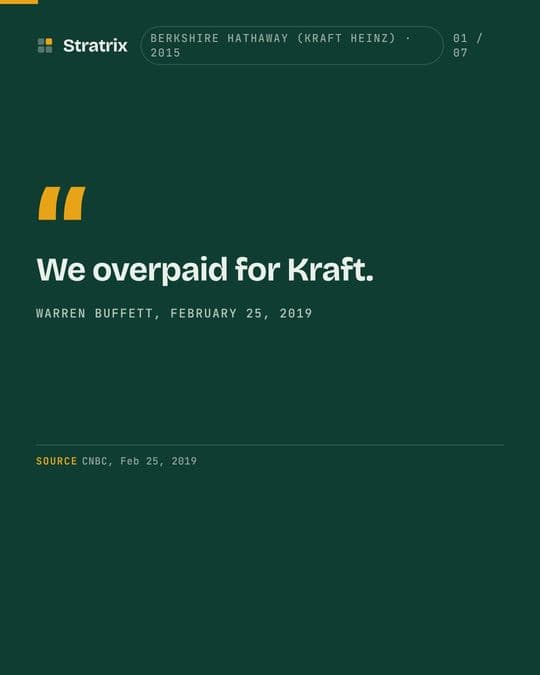
Kraft Heinz shows what happens when the earnings are not what the price assumed. In 2015 Berkshire Hathaway and 3G put in an additional $10 billion to fund the special dividend to Kraft shareholders. In the fourth quarter of 2018 Kraft Heinz reported a $15.4 billion goodwill impairment, and Berkshire took a $3 billion write-down on its investment. Warren Buffett said in February 2019, "We overpaid for Kraft," noting the business used about $7 billion in tangible assets while Berkshire paid roughly $100 billion in total asset value. By September 2025 Berkshire's 27.5% stake, which cost $9.8 billion, was worth about $8.9 billion.
Salesforce paid $27.7 billion for Slack in stock and cash, a 54% premium over Slack's roughly $18 billion market value, on the thesis that Slack would become the new interface for Salesforce. Its case finds the thesis unproven. The two earlier platform deals are easier to read: in fiscal 2024 the segment holding MuleSoft and Tableau produced $5,189 million of subscription and support revenue, about 16% of total subscription and support revenue.
Write every deal as earnings and a multiple
For each acquisition, state the earnings bought, the price paid, and the multiple that results, on the same profit measure you use for your own shares. Then set that multiple against your own. A deal that cannot be written this way cannot be compared with a buyback, and a machine whose deals cannot be compared is not being managed.
Where the debt stops
A machine funded with debt has a stop date, and it is set by the balance sheet rather than by the pipeline. AB InBev arranged a record $75 billion bridge in November 2015 to buy SABMiller, a deal its own filing valued at roughly £79 billion. By January 27, 2016, after roughly $47 billion of bond issuances, it had canceled $42.5 billion of the facility. Net debt was still $67.6 billion at the end of 2023, down from $69.7 billion, at 3.38x normalized EBITDA against a stated optimal target of about 2x. Moody's and S&P upgraded AB InBev in early 2024, citing the deleveraging.
Dell agreed on October 12, 2015 to buy EMC in a transaction valued at about $67 billion, with banks committing up to $49.5 billion of debt financing. The years after were spent paying for it: Dell sold Dell Services, the Dell Software Group and an enterprise content division for roughly $7 billion aimed at the merger debt, and the 2021 spin-off of VMware came with an $11.5 to $12.0 billion special cash dividend that flowed largely to Dell. A debt-funded deal can still be the right move, but it ends the machine for as long as the debt takes to retire.
What you can read before you sign
Some of the cost of a deal is on the record before it closes. Bayer closed its acquisition of Monsanto on June 7, 2018 at $128 a share, about $63 billion including Monsanto's debt. IARC had classified glyphosate as a probable human carcinogen in March 2015, and Monsanto was already defending over 120 toxic-tort cases. Bayer lost roughly 40% of its market capitalization after closing; 55.5% of shareholders voted against ratifying management's actions at the 2019 annual meeting; and in June 2020 Bayer announced $10.1 billion to $10.9 billion to resolve Roundup litigation.
The opposite case is a price set by someone else. UBS agreed on March 19, 2023 to absorb Credit Suisse in an all-share deal for total consideration of CHF 3 billion, with over CHF 100 billion of liquidity from the Swiss National Bank and a government loss guarantee of up to CHF 9 billion. UBS booked final negative goodwill of USD 27.7 billion. Its chairman's framing was exact: "This acquisition is attractive for UBS shareholders but, let us be clear, as far as Credit Suisse is concerned, this is an emergency rescue." On October 1, 2025 a Swiss court ruled the write-off of Credit Suisse's AT1 bonds unlawful, a cost no spread calculation would have priced.
What these cases show
Each case is drawn from the Stratrix case library and checked against the filings and reporting listed under Sources. The last column says what each one does not establish.
| Company | What the buying was paid with | What happened | What it does not establish |
|---|---|---|---|
| Cisco, 1993 and 2024 | Shares for Crescendo; cash for Splunk | About $97 million in stock in 1993; about $28 billion in cash in 2024 | What Splunk earns against its price |
| Exxon, 2023 | All stock, thin premium | $59.5 billion in equity; synergy target raised to $4 billion a year | How much of the uplift is the oil price |
| Salesforce, 2013 to 2021 | Valuation as currency | Five platform deals from $2.5 billion to $27.7 billion | Whether Slack will prove its thesis |
| Broadcom, 2022 | Cash, stock and term loans | Targeted about $8.5 billion of EBITDA; record $31.9 billion adjusted EBITDA in 2024 | How much of that came from VMware alone |
| Kraft Heinz, 2015 | A 49% stake for Kraft holders and a $10 billion special dividend | $15.4 billion goodwill impairment in 2018 | That the earnings were knowable at signing |
| AB InBev, 2015 | A $75 billion bridge, then bonds | Net debt $67.6 billion at 3.38x EBITDA in 2023 | When the target leverage will be reached |
| Dell, 2015 | Up to $49.5 billion of debt | Roughly $7 billion of asset sales and a VMware dividend to pay it down | What standing still would have cost |
| Bayer, 2018 | $128 a share, about $63 billion with debt | About 40% of market value lost after closing; $10.1 billion to $10.9 billion for Roundup | That the litigation outcome was predictable in size |
| UBS, 2023 | Shares, at a price set by the state | USD 27.7 billion of negative goodwill; AT1 write-off ruled unlawful in 2025 | Anything about a deal UBS could have chosen not to do |
Running the decision
A sequence for the next planning cycle
Split the growth
Take the last five years and the plan. Separate what the businesses you owned produced from what you bought, and state the plan's purchase bill a year at the multiple you have actually been paying.
State your own multiple
On one profit measure, the one you will use for every deal. If no one in the room can say what the company trades on, stop: nothing else can be priced.
Rewrite past deals as multiples
Earnings bought, price paid, multiple. Your own record is the best estimate of what you will pay next.
Set each deal against a buyback
What would the same money retire of your own earnings? A deal that pays a higher multiple than your own needs an operating case to beat that, and should be argued as one.
Find the year the money stops
Debt capacity, cash generation and share issuance against the purchase bill. Compare the year with the length of the plan.
Read what is already public
Litigation, regulatory findings, lapsed licenses, pending claims. A liability on the record before signing belongs in the price, not in the integration plan.
What this method cannot tell you
It prices the machine, not any deal in it. Integration, synergies, the people who leave and what the acquired businesses do afterward are real, often decisive, and outside this arithmetic. No disclosure separates the effect of a multiple from everything else moving in the same period, and none of the cases above is presented as doing so.
It also cannot forecast your own multiple, which is the input the whole engine runs on and the one no one controls. The cases support recognizing a mechanism; they cannot support a success rate for serial acquirers, and this page does not claim one.
Watch these decisions
Short videos built from the same Decision Records as this page.
Questions
What is a serial acquisition strategy?
A plan in which a meaningful part of growth is bought rather than grown, through a series of acquisitions rather than one. Its engine is the gap between the multiple the market pays for the acquirer's earnings and the multiple the acquirer pays for the earnings it buys.
What is multiple arbitrage in acquisitions?
Buying earnings at a lower multiple than the market pays for your own. Buy a dollar of profit at eleven times and carry it at seventeen, and six times that dollar appears on the day. It stops working when either multiple moves.
How do you compare an acquisition with a share buyback?
State the deal as earnings bought at a multiple, then ask what the same money would retire of your own earnings. If the multiple paid is above your own, the buyback retires more earnings per dollar, and the deal needs an operating case to beat it.
How much debt is too much for a serial acquirer?
Set the debt capacity against the plan's purchase bill and find the year it runs out. AB InBev bought SABMiller with a record $75 billion bridge and still carried net debt of $67.6 billion at the end of 2023, at 3.38x EBITDA against a target of about 2x.
Is acquiring a normal way to grow?
Yes. The argument is not against acquiring but for stating each price as a multiple of earnings rather than a transaction value, so it can be compared with another deal, with a buyback and with the company's own record.
Continue learning
Sources & further reading
- Cisco Systems Newsroom (1993). Cisco Systems Finalizes Agreement to Acquire Crescendo Communications.
- Cisco Systems, Inc. (Form 8-K) (2024). Cisco Completes Acquisition of Splunk.
- ExxonMobil Corporation (Form 8-K) (2023). ExxonMobil Announces Merger with Pioneer Natural Resources in an All-Stock Transaction.
- ExxonMobil Corporation (2023). ExxonMobil Announces Merger with Pioneer Natural Resources in an All-Stock Transaction (Investor Relations).
- ExxonMobil Corporation (2025). ExxonMobil Raises Its 2030 Plan.
- Salesforce, Inc. (2021). Salesforce Acquisitions.
- Salesforce.com, Inc. (Form 8-K) (2013). ExactTarget Acquisition Agreement.
- Salesforce.com, Inc. (2020). Salesforce Signs Definitive Agreement to Acquire Slack.
- Salesforce, Inc. (Form 8-K) (2024). Q4 and Full Year FY2024 Earnings Press Release.
- Broadcom Inc. (Form 8-K) (2022). Broadcom to Acquire VMware for Approximately $61 Billion in Cash and Stock.
- Broadcom Inc. (Form 8-K) (2024). Broadcom Q4 and FY2024 Financial Results.
- NetworkTigers (2025). A History of Broadcom: From HP Origins to VMware and AI.
- The Kraft Heinz Company (2015). H.J. Heinz Company and Kraft Foods Group Sign Definitive Merger Agreement.
- CNBC (2019). Buffett, after last week's stock plunge, says Berkshire Hathaway 'overpaid' for Kraft.
- CNBC (2019). Kraft Heinz doubt mounts after Kraft, Oscar Meyer write down.
- CNBC (2025). Warren Buffett's public Kraft Heinz criticism is extremely unusual for the typically passive owner.
- Reuters / Yahoo Finance (2015). LPC: AB InBev backs SABMiller buy with record US$75bn loan.
- Anheuser-Busch InBev S.A. (Form 425) (2016). Revised and Final Terms of the Transaction (AB InBev / SABMiller).
- Anheuser-Busch InBev S.A. (Form 6-K) (2016). Form 6-K, FY2016 (Exhibit 99.2).
- AB InBev / BusinessWire (2024). AB InBev Reports Full Year and Fourth Quarter 2023 Results.
- AB InBev (JSE filing) (2024). AB InBev Full Year and Fourth Quarter 2023 Results Press Release.
- EMC Corporation (Form 8-K) (2015). Michael S. Dell, MSD Partners and Silver Lake Lead Transaction to Combine Dell and EMC.
- BetaBoston (Boston Globe) (2016). Dell denies any 'headwinds' in $50B debt sale for EMC buyout.
- VMware Inc. (Form 8-K) (2021). VMware and Dell Technologies Reach Agreement Regarding Spin-Off.
- Monsanto Company (Form 8-K) (2018). Bayer Closes Monsanto Acquisition.
- Cohen Milstein Sellers & Toll PLLC (2025). In re Bayer AG Securities Litigation: $38M Settlement Approval.
- Fierce Pharma (citing the Financial Times) (2019). Bayer investors revolt against CEO but only want no-confidence vote to stay symbolic.
- Bayer AG (2020). Bayer announces agreements to resolve major legacy Monsanto litigation.
- UBS Group AG (Form 6-K) (2023). UBS press release, 20 March 2023.
- UBS Group AG (2024). UBS Group Annual Report 2023.
- Swiss Federal Administrative Court (2025). Unlawful write-off of AT1 capital instruments.
More to learn
Other foundational guides worth reading.
When to Discontinue a Product: How to Price a Sunset Before You Announce It
Every room knows what a product loses a year. Almost none knows what its customers spend with the company on everything else, or how many would leave with it. That second number decides whether retiring it saves money or costs it.
Strategy DevelopmentMake or Buy: How to Decide What Your Company Must Own
You can outsource anything whose interface you can specify, and nothing you cannot. The test is whether a supplier who has never seen the work could quote from what you hold today; the number is the probability of having to buy the capability back.
Growth & ExpansionExpansion Plan: How Fast Can a Rollout Actually Go?
Plans express themselves as destinations: two hundred stores, twelve countries. A destination cannot be wrong, only late. A rate can be checked, and most expansions fail because the rate was faster than the operation behind it could carry.
Pricing StrategyPricing Model Change: How to Move to Subscription or Usage Pricing
A pricing model change moves up to four layers at once: the unit you charge for, the shape of the cash, the buyer who signs, and the promise the customer relies on. Name which ones you are moving, size the trough against carrying on unchanged, and run the case again with the volume uplift set to zero.
Platform StrategyProduct to Platform: When to Open Your Product to Third Parties
A product becomes a platform when a take rate exists that pays for the platform layer and still leaves a third party better off than building alone. Cost the layer on its own, ask a builder what it earns without you, and set the rate inside the corridor between those two numbers.
Strategy FundamentalsVision, Mission, and Values
How to craft the foundational statements that align your organization—and why most get them wrong.
See this framework in the wild.
Follow it across the companies and lenses where it actually shaped the strategy.