Core insight
The usual taxonomy of switching costs, scale, network effects and brand describes how protection is produced, not whether it is still being produced or for how much longer. The test is an inequality in the challenger's spreadsheet: what it must spend to win your customer, against what that customer then earns it.
Why most moat analysis proves nothing
A company earning good returns always has an explanation for them. Turning that explanation into a claim about the future requires a different document, and the usual taxonomy does not supply it. Calling an advantage a network effect or a switching cost says how protection is produced. It does not say whether the protection is still being produced, or for how much longer.
The question a board actually needs answered is narrower and testable: what would it cost a challenger to take one of your customers, and is the customer worth that much to them? If the answer is yes, the moat has already been crossed, whatever the taxonomy says.
The gap between what a challenger must spend to win your customer and what that customer is then worth to the challenger. A positive gap protects you; the year it closes is the year the protection ends.
The four sources of a gap, and what erodes each
Every durable gap comes from one of four sources. Each has its own way of eroding, and each shows the erosion somewhere specific before it reaches the income statement.
| The source | What erodes it | Where you see it first |
|---|---|---|
| Switching friction | A third party builds the migration path. | Migration tooling appears, priced well below what you assumed a move would cost. |
| Scale economics | A supplier makes the capability rentable. | A smaller competitor holds a comparable unit cost. Ask how; the answer is a supplier's name. |
| Demand-side returns | Multi-homing, once a customer can use both without penalty. | Accounts running you alongside somebody else and calling it a trial that never ends. |
| Access | The channel changes, or the rule does. | A new route to your customer that does not pass through the thing you control. |
Naming the source matters because the defense differs. A switching-friction moat is defended by making migration expensive; a scale moat by staying ahead of what suppliers will rent; a demand-side moat by making multi-homing costly; an access moat by holding the channel or the rule. A company that defends the wrong one spends money and keeps the exposure.
Switching friction: watch for the migration path
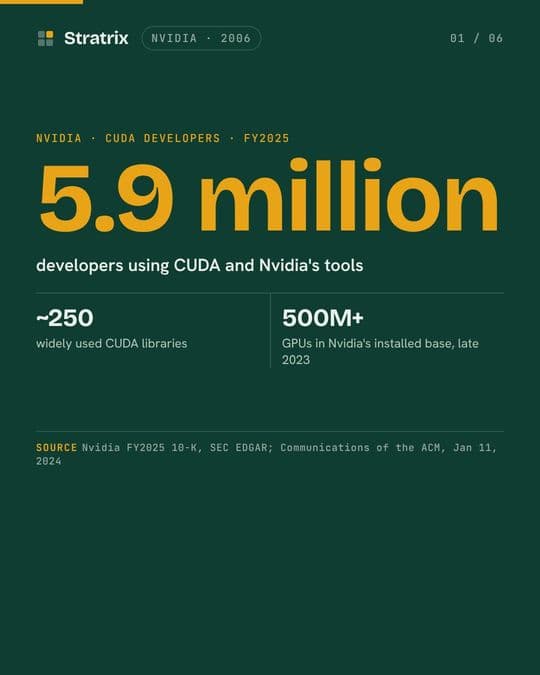
Nvidia's protection is less the chip than what has been written for it: over 5.9 million developers used CUDA and Nvidia's other software tools as of its fiscal 2025 filing, and in AI training its share exceeds 90%.
The erosion arrives the way the table predicts. AMD funded ZLUDA, a compatibility layer that runs unmodified CUDA binaries on AMD GPUs, and the project was open-sourced in February 2024. A migration path built by someone else is the first sign that a switching-friction moat is being priced, even while the share still looks safe.
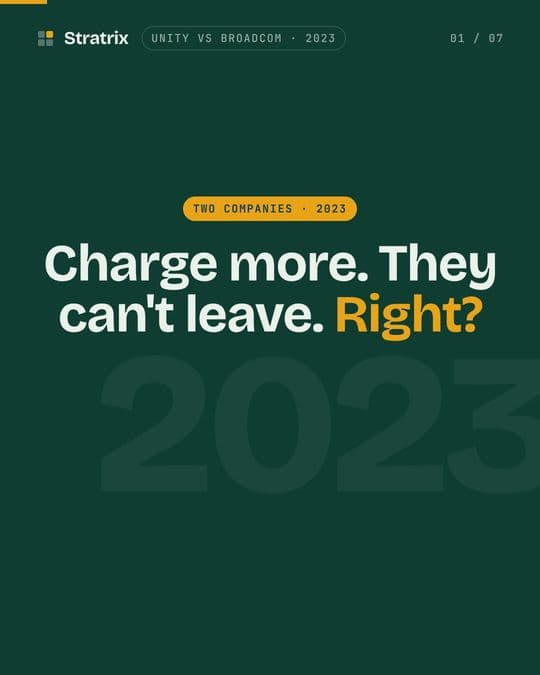
Unity shows the opposite mistake: charging as if the friction were higher than it was. In September 2023 it announced a per-install runtime fee aimed at the successful games it most needed to keep. It canceled the fee entirely a year later and returned to seat pricing. By 2024 Unreal held 31% of Steam game sales by revenue against Unity's 26%, passing it for the first time since 2018.
Scale economics: watch for what suppliers will rent
Coca-Cola's wall is not the formula, which it kept a trade secret from 1891 rather than patent. It is a network of 225 bottlers and about $5 billion a year of marketing upkeep, assembled over a century.
Scale has a ceiling, and it is usually a customer. PepsiCo's Frito-Lay runs nearly 15,000 routes, the largest direct-store-delivery system in North America, built because owning the route controls placement and freshness. In December 2025 a federal judge unsealed the FTC's complaint alleging PepsiCo gave Walmart preferential pricing not offered to smaller retailers. The scale moat held against rivals and bent in front of the largest buyer.
Demand-side returns: watch for multi-homing
Visa's advantage traces to a governance choice in 1970: reincorporating the card program as a company owned by the issuing banks, which made rival banks co-owners rather than competitors. In fiscal 2024 Visa processed 234 billion transactions on its own network.
Airbnb is the case to watch. With 28% of its listings cross-listed elsewhere, its hosts already multi-home. From October 2025 it moved hosts connected through property-management software to a mandatory 15.5% host-only fee, converging with Booking.com while Vrbo stayed cheaper for hosts. That is a bet that the demand advantage is strong enough to charge for while hosts can list on both, and no dated outcome yet says whether it holds.
Access: watch the channel and the rule
Palantir's position rests partly on a court ruling. In 2016 the Court of Federal Claims found the Army had ignored a 1994 procurement law by never checking whether a commercial product existed, and in 2018 an appeals court agreed the Army had acted arbitrarily and capriciously.
American Express defended its access the same way: when Visa and Mastercard settled the government's challenge to anti-steering rules, Amex litigated, and in 2018 the Supreme Court upheld the rules 5-4. Those rules are what let it hold its higher merchant price.
An access moat erodes when the middle changes hands. Roku's value was its neutrality between Netflix, Disney+ and every other service. In June 2026 Fox agreed to acquire it at about $22 billion, putting a content owner in control of the platform its rivals depend on.
An access rule can also bind the holder. Diageo sits behind a UK-built wall around 40% of all Scotch whisky, and in 2018 the Scotch Whisky Association declined Diageo's own request to finish single malts in tequila barrels. The rule that keeps rivals out keeps the incumbent in.
Compute the gap in the challenger's spreadsheet
Once the source is named, put a number on it, and do the arithmetic from the challenger's side. The gap is what it costs a challenger to win one of your customers, less what that customer is then worth to them.
Three challengers, not one
Compute the gap three times: against a startup, against a neighbor who already sells to your customer, and against an entrant earning its return elsewhere. Then find the largest inducement each can afford to pay your customer to move, and the year that inducement clears what a move actually costs the customer.
The three answers usually differ by years. In the worked case used in the Moat Anatomy Strategy Pack, the gap holds for all ten years against a startup, for five against the neighbor, and for one against an entrant earning its return elsewhere. Nothing about the company changes between those three readings; only whose spreadsheet the arithmetic is done in.
An incumbent's own behavior is often the clearest reading. Adobe agreed to buy Figma for $20 billion and, with no clear path to approval from the European Commission and the UK CMA, paid a $1 billion fee in December 2023 to walk away.
What these cases show
Each case is drawn from the Stratrix case library and checked against the filings and reporting listed under Sources. The last column says what each one does not establish.
| Company | Source of the gap | What happened | What it does not establish |
|---|---|---|---|
| Nvidia, 2006 | Switching friction: CUDA | Over 5.9 million developers by fiscal 2025; AMD funded a CUDA compatibility layer, open-sourced in 2024 | How fast the friction falls once a migration path exists |
| Unity, 2023 | Switching friction it overestimated | Canceled its per-install fee in 2024; Unreal passed it on Steam revenue, 31% to 26% | That the fee alone moved the share |
| Coca-Cola, 1891 | Scale: 225 bottlers and marketing | About $5 billion a year of marketing in 2023 | What a challenger would need to spend to match it |
| PepsiCo, 2010 | Scale: direct-store delivery | Nearly 15,000 routes; an FTC complaint over preferential pricing to Walmart, unsealed in 2025 | That the complaint had merit |
| Visa, 1970 | Demand-side returns: issuer-owned network | 234 billion transactions on its own network in fiscal 2024 | That the governance choice was the cause rather than the start |
| Airbnb, 2025 | Demand-side returns, with 28% of listings cross-listed | Made a 15.5% host fee mandatory for software-connected hosts | Whether hosts stay; no outcome is dated yet |
| Palantir, 2016 | Access: a procurement ruling | Injunction upheld on appeal in 2018 | That the ruling, not the product, wins the contracts |
| Roku, 2026 | Access: neutrality | Agreed to a $22 billion sale to Fox, a content owner | What rival services will do; the deal had not closed |
Running the analysis
A sequence for a strategy team
Run the premium test first
One analyst, one week, your own deal records: is the discount on competitive deals rising? If it is, the crossing has already happened and the question changes.
Name the source
Switching friction, scale economics, demand-side returns or access. If the advantage is a brand, ask which of the four it actually produces.
Ask five customers what leaving would cost them
It is the hardest input to get and the cheapest. Public pricing and published margins supply most of the rest.
Compute the gap against three challengers
A startup, a neighbor who already sells to your customer, and an entrant earning its return elsewhere.
Date the crossing
The year the largest inducement a challenger can afford clears what a move costs your customer.
Set the erosion signal
The specific thing to watch for your source: a migration tool, a rentable capability, multi-homing, or a new route to the customer.
What this method cannot tell you
Moats are identified by their returns, so any collection of them is selected on the outcome it is being used to explain. The businesses with the same mechanism and no returns are invisible. The cases above support recognizing a mechanism. They cannot support a survival rate, and this page does not claim one.
The method also does not say how wide a moat should be. It replaces that question with a narrower one that has an answer: whether, and until when, the arithmetic still favors you in a challenger's spreadsheet.
Watch these decisions
Short videos built from the same Decision Records as this page.
Questions
What is a competitive moat?
A competitive moat is an advantage that makes it expensive for a challenger to take your customers. In testable terms, it is the gap between what a challenger must spend to win a customer and what that customer is then worth to the challenger.
How do you analyze a company's moat?
Name which of four sources produces the advantage (switching friction, scale economics, demand-side returns or access), compute the gap from the challenger's side against three kinds of challenger, and identify the specific signal that would show the source eroding.
How can you tell a moat is eroding?
Each source erodes in its own way: a migration tool appears, a supplier makes your scale rentable, customers start using you alongside a rival, or a new route to the customer bypasses what you control. A rising discount on competitive deals is the earliest sign in your own records.
Is a brand a moat?
Only through one of the four sources. If customers accept a higher price with no alternative seriously considered, the brand is producing switching friction. If it gives you access a challenger cannot get, it is producing access. If it produces neither, it is an explanation, not a moat.
What is the difference between a moat and a competitive advantage?
A competitive advantage explains why returns are high today. A moat is a claim about the future: that a challenger cannot profitably take your customers for some number of years. The analysis is how you turn the first into the second.
Continue learning
Sources & further reading
- NVIDIA Corporation (2025). Form 10-K, fiscal 2025.Over 5.9 million developers use CUDA and Nvidia's other software tools.
- Silicon Analysts (2026). NVIDIA AI GPU Market Share 2026.
- Phoronix (2024). AMD Quietly Funded A Drop-In CUDA Implementation Built On ROCm: It's Now Open-Source.
- Unity Technologies (2024). Unity is Canceling the Runtime Fee.
- GameDev Reports / Video Game Insights (2025). Game Engines on Steam in 2025.
- Wikipedia (2025). Coca-Cola formula.
- ElectroIQ (citing company disclosures) (2026). Coca-Cola Statistics.
- Frito-Lay North America / PepsiCo (2019). Frito-Lay North America Fact Sheet.
- Institute for Local Self-Reliance (2025). New Details Emerge in Accusation of Pepsi's Predatory Business Practices Favoring Walmart.
- Wikipedia (2026). Visa Inc..
- Visa Inc. (2024). Form 10-K Annual Report, fiscal 2024.
- RentalScaleUp by PriceLabs (2025). Airbnb Host Fee Change Correction: How to Actually Keep Your Payout.
- Federal News Network (2018). Court: Army ignored law's preference for commercial items in major intel procurement.
- Supreme Court of the United States (2018). Ohio v. American Express Co..
- Roku, Inc. (Form 8-K) (2026). Fox Corporation to Acquire Roku, Inc..
- NBC News (2026). Fox to buy Roku for $22 billion.
- Whisky Advocate (2018). Is Diageo Trying to Rewrite the Rules of Scotch?.
- Adobe Inc. (Form 8-K) (2023). Adobe and Figma Mutually Agree to Terminate Merger Agreement.
More to learn
Other foundational guides worth reading.
How to Respond to a New Competitor: Price Its Money, Not Its Product
Size a new competitor by its money, not its demo. Divide what it has for your market by what it costs it to take one of your customers, price what those customers would have earned you, and answer only if answering on every customer it reaches costs less than that.
Growth & ExpansionExpansion Plan: How Fast Can a Rollout Actually Go?
Plans express themselves as destinations: two hundred stores, twelve countries. A destination cannot be wrong, only late. A rate can be checked, and most expansions fail because the rate was faster than the operation behind it could carry.
Growth & PortfolioCompany Reorganization: What It Costs and How Long It Must Last
A reorganization costs a year: the one-time charge plus the drag of months in which management attends to the company instead of its customers. It pays only if the new structure changes enough each year, for enough years. Name the line you are redrawing, put a number on what it will change, and compare the years it must stand with how long the last structure stood.
Pricing StrategyPrice Increase Strategy: How Much Volume Can a Rise Afford to Lose?
A price rise is decided by two numbers. The share of volume it can afford to lose is arithmetic on the rise and your contribution margin; the share it will lose comes from measuring your own last rise against the trend before it. Raise as far as the gap between them allows, net of what the field discounts away.
Crisis ManagementCorporate Crisis Response: What One More Quarter of Delay Costs
A corporate crisis is priced on the gap between when somebody inside knew and when the company acted, not on the defect itself. Find the earliest internal date, cost what one more quarter of delay adds, and act before the expected penalty passes the cost of the fix.
Strategy FundamentalsVision, Mission, and Values
How to craft the foundational statements that align your organization—and why most get them wrong.
See this framework in the wild.
Follow it across the companies and lenses where it actually shaped the strategy.