Core insight
The saving in a cost paper is usually right; what is missing is what the company bought with it, a smaller capability with a price to restore. Two divisions put that half on the page: what rebuilding would cost over the annual saving, and the annual saving over the profit running through what was cut.
Why a cost cut is a purchase, not only a saving
Every cost paper says what comes out of the run rate, and that figure is usually right. What no paper says is what the company acquired in exchange: a capability that used to exist and now does not, with a price to restore it and a time to deliver it. Both are knowable. Neither is usually requested.
The asymmetry is structural rather than anybody's fault. The saving arrives immediately and in one line. What it cost arrives slowly and in several, as slower delivery, accounts that stop renewing and work that takes nine months instead of three, and it is attributed to everything else that happened that year. Whoever proposed the cut can estimate the saving. Only whoever will work without the capability can estimate the loss, and they are usually not asked.
What did the cut buy, and what would buying it back cost?
Two divisions that put the other half on the page
| The figure | How it is built | What it tells you |
|---|---|---|
| What the cut removes | A named capability, in words a customer would recognize, not a cost line. | Who would notice if it stopped working, and how fast. |
| The reversal price | What rebuilding the capability would cost, divided by the annual saving. | How many years of the saving buying it back would consume, read against the horizon the cut is defended over. |
| The loss that cancels the saving | The annual saving, divided by the profit running through what was cut. | The share of that profit you could lose before the cut saves nothing. In most companies it is a single-digit percentage. |
| The signal and its owner | A measure tied to what was cut, with a threshold. | Who watches it, and what happens when it crosses. |
A worked example
In the worked case used in the Cost Cut Strategy Pack, the cut saves $62m a year over a stated five-year horizon, $310m in all, against a rebuild costed at $240m and three years by the person who would have to do it. So the reversal is affordable, at 3.9 of the 5 years. What the paper never said is that an 11.7 percent loss in the profit running through those accounts cancels the entire saving, and that the capability took eleven years to build.
A program is a set of cuts, and each needs its own version of this page. The sum of the reversal prices across a program is the number no one has. If a cut's saving exceeds the profit behind it, it is an exit rather than a cut, and it should be argued as one.
Cuts bought back in public: the reversal price
Boeing sold its Wichita, Tulsa and McAlester commercial-airplane operations to Onex for about $900 million in cash in 2005, to become what it called a large-scale systems integrator. Boeing's Wichita division had incurred about $2.2 billion in annual costs in 2004. On July 1, 2024 Boeing agreed to reacquire Spirit AeroSystems at a total enterprise value of about $8.3 billion, reversing the largest divestment in its modern history.
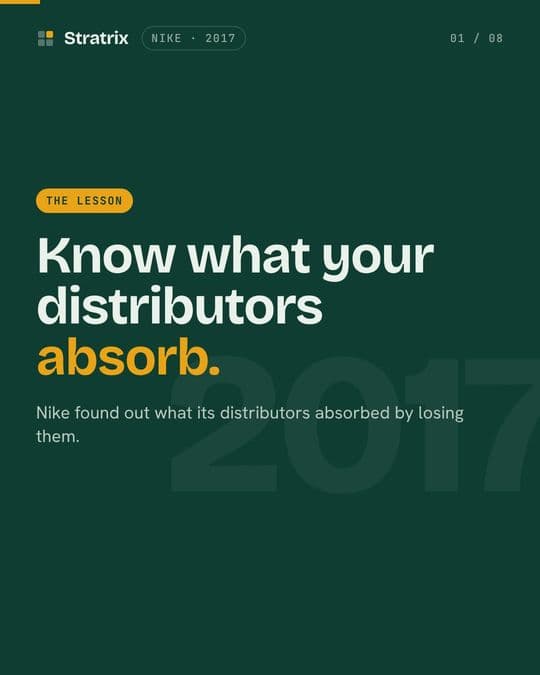
Nike announced its Consumer Direct Offense on June 15, 2017, and by September 2021 Nike had exited about 50% of its retail partners. By September 2022 Nike's inventory had ballooned 44%. In March 2024 Nike's CFO said the direct strategy had added complexity and inefficiency, and Nike returned to wholesale partners and announced a $2 billion cost-savings plan. In 2025 Nike products returned to Amazon after a six-year absence.
Meta cut headcount from 86,482 to 67,317 in its 2023 Year of Efficiency, a 22% drop, while Meta's revenue rose 16% to $134.90 billion. By the end of 2024 Meta's headcount had risen to 74,067, up 10%, reversing a significant portion of the cuts within one year of their completion.
The question these cases raise is not whether the saving arrived. It is whether anybody priced the reversal before it was needed, while the people who could estimate it were still there to ask.
The loss that cancels the saving
On March 28, 2007 Circuit City fired about 3,400 store employees, about 9 percent of its in-store workforce of 40,000, because they were paid "well above the market-based salary range for their role." Circuit City expected the firings and related moves to cut expenses by $110 million in fiscal 2008 and $140 million a year from fiscal 2009, against $9.9 million in termination costs.
By May 2007 analysts were attributing Circuit City's first-quarter loss to the job cuts, and a Deutsche Bank analyst wrote that the labor change had hurt service levels and was handing market share to Best Buy. Circuit City filed for Chapter 11 on November 10, 2008, citing vendor credit and liquidity rather than its labor decisions, and closed its last 567 stores on March 8, 2009.
The saving was real. What the paper lacked was the second division: how small a loss in the profit running through those sales floors would have canceled it. This page does not claim the cut caused the collapse; the company's own filing pointed elsewhere, and no arithmetic available from outside can settle it.
Cuts that worked, and what they kept
On January 4, 2023 Salesforce announced it would cut roughly 10% of its workforce, about 8,000 people, and reduce office space, with charges of up to $1.4 billion for headcount and $650 million for real estate. Salesforce's non-GAAP operating margin for fiscal 2024 came in at 30.5%, past a 25% target set for fiscal 2026, on revenue of $34.86 billion, up 11%. The cuts did not stop there: across 2022 to 2025 Salesforce cut an estimated 13,000 to 14,000 people, and Marc Benioff later described the 2023 layoffs as a "complete dumpster fire".
Nucor cut pay instead of people. In 2009 Nucor lost money for the first full year in its history, a $294 million net loss, and kept roughly 20,000 jobs by cutting hours and letting production bonuses go. Nucor's pay-for-performance system let payroll fall with production, so the cut came out of pay rather than out of the workforce.
Best Buy set a $725 million annualized cost reduction target under Renew Blue and reported $765 million after one fiscal year; by the end of fiscal 2015 Best Buy's figure was $1.02 billion. Best Buy cut while it invested: it made price matching permanent and opened 1,400 Samsung and 600 Windows stores-within-a-store, and Best Buy's revenue recovered from about $39.8 billion in fiscal 2013 to $42.4 billion in fiscal 2014.
Airbnb cut 1,900 jobs, 25% of its workforce, in May 2020, and cut its transportation division, hotel initiatives and luxury stays to refocus on its core business. Airbnb opened on the Nasdaq in December 2020 at an $86.5 billion market cap. That outcome says little about the cut itself: the recovery came from a kind of travel Airbnb never had to invent.
A cost line cannot be rebuilt. A capability can, at a price and on a delivery time. Write the capability down, then ask the person who would have to rebuild it what that would take and how long it took the first time.
What these cases show
Each case is drawn from the Stratrix case library and checked against the filings and reporting listed under Sources. The last column says what each one does not establish.
| Company | What was cut | What happened | What it does not establish |
|---|---|---|---|
| Boeing, 2005 | The Wichita fuselage operations, sold | Agreed in 2024 to reacquire Spirit at about $8.3 billion | What keeping the plant would have cost Boeing over the same years |
| Nike, 2017 | About 50% of its retail partners | Inventory up 44% by 2022; back on Amazon in 2025 | How much of the reversal was the channel cut rather than demand |
| Meta, 2023 | Headcount, down 22% | Revenue up 16%; headcount up 10% the following year | Whether the rehiring rebuilt what was cut or something new |
| Circuit City, 2007 | About 3,400 above-market store staff | Chapter 11 in 2008; 567 stores closed in 2009 | That the cut caused the collapse |
| Salesforce, 2023 | About 10% of staff and office space | Non-GAAP operating margin of 30.5% in fiscal 2024 | What the later rounds of cuts cost |
| Nucor, 2009 | Pay and hours, not jobs | Roughly 20,000 jobs kept through a $294 million loss | That the same flex works without a pay-for-performance system |
| Best Buy, 2012 | Renew Blue cost program | $1.02 billion in annualized reductions by fiscal 2015 | How much of the recovery came from cuts rather than vendor deals |
| Airbnb, 2020 | 25% of staff and its non-core lines | Listed at an $86.5 billion market cap in December 2020 | That the cut, rather than the travel rebound, saved the company |
Running the decision
A sequence for each cut in the program
Name what the cut removes
The capability, in a sentence a customer would recognize, not the cost line it sits in.
Get the rebuild estimate from the person who would do it
The cost and time to restore the capability, and how long it took to build the first time. If no one will give one, stop: the cut cannot be judged yet.
Compute the reversal price
The rebuild cost divided by the annual saving, in years, read against the horizon the decision is being defended over.
Compute the loss that cancels the saving
The annual saving divided by the profit running through what was cut. Put the percentage in the paper, in a sentence.
Flag a cut that is really an exit
If the saving exceeds the profit behind the cut, say so, and argue it as an exit.
Stage it against a signal
A measure tied to what was cut, a threshold, and a named owner who reports it on a fixed line, decided before the cut is announced.
What this method cannot tell you
It does not price the effect on the people who stay. It handles one cut at a time. And it cannot attribute a decline: when a cut delivers its saving and revenue then falls, no arithmetic available from outside can say how much of the second the first caused.
The cases support recognizing a mechanism, not a rate. Some of the cuts above worked and some did not, none of them is a controlled test, and this page does not claim to know how often a cut of any kind succeeds.
Watch these decisions
Short videos built from the same Decision Records as this page.
Questions
How do you evaluate a cost reduction program?
Cut by cut. For each, write down the capability it removes, what rebuilding it would cost and how long that would take, and divide the rebuild cost by the annual saving. Then divide the saving by the profit running through what was cut, which tells you how small a loss would cancel it.
What is the biggest risk in cost cutting?
That the saving is booked and the capability it removes is not. Circuit City expected its 2007 firings to cut expenses by $110 million in fiscal 2008; the paper did not say what losing its most experienced sales staff could cost.
Should we cut pay or cut jobs?
It depends on what you need back when demand returns. Nucor kept roughly 20,000 jobs through its 2009 loss by letting hours and bonuses fall, because its pay system was built to flex with production.
How do you know if a cost cut went too far?
Set the signal before the cut: a measure tied to what was removed, a threshold, and an owner. If the signal crosses, you already know what reversing will cost, because you priced it before you cut.
Is a cost reduction program the same as a turnaround?
No. A turnaround needs the business to earn more afterward, not just spend less. A cost program can be one part of a turnaround, but a program that only cuts has not shown that the business will grow back.
Continue learning
Sources & further reading
- The Boeing Company (Form 8-K) (2005). Boeing to Sell Commercial Airplanes Operations in Kansas and Oklahoma to Onex.
- Spirit AeroSystems Holdings, Inc. (Form 8-K) (2024). Spirit AeroSystems Announces Acquisition by Boeing in $8.3 Billion Transaction.
- The Seattle Times (2024). Boeing seeks to buy Spirit Aero, 19 years after selling troubled Wichita plant.
- Modern Retail (2023). After years of focusing on DTC, Nike is quietly bringing more wholesale partners back into the fold.
- Modern Retail (2023). As Nike reintroduces wholesale, it loses its previous leverage.
- Yahoo Finance / Reuters (2024). Nike addresses flaws in DTC strategy as Q3 revenues come in flat.
- WWD / Footwear News (2025). All the Retailers Nike Left and Then Returned.
- Meta Platforms, Inc. (2024). Meta Reports Fourth Quarter and Full Year 2023 Results.
- Meta Platforms, Inc. (PR Newswire) (2025). Meta Reports Fourth Quarter and Full Year 2024 Results.
- Circuit City Stores, Inc. (Form 8-K) (2007). Item 2.05 Costs Associated with Exit or Disposal Activities.
- The Philadelphia Inquirer (2007). Circuit City plans to replace 3,400 with low-cost hires.
- The Washington Post (2007). Circuit City Cuts 3,400 'Overpaid' Workers.
- The Washington Post (2007). Circuit City's Job Cuts Backfiring, Analysts Say.
- Circuit City Stores, Inc. (Form 8-K) (2008). Chapter 11 Filing Press Release.
- NPR (2009). Going Out Of Business: Circuit City.
- Salesforce, Inc. (Form 8-K) (2023). Restructuring Plan Announcement.
- Salesforce, Inc. (Form 8-K) (2024). Q4 and FY2024 Earnings Release.
- Al Jazeera (2025). Salesforce lays off thousands despite strong earnings report.
- Foundry-Planet / Milwaukee Journal Sentinel (2011). No layoffs at Nucor despite bad economy.
- Nucor Corporation (SEC correspondence) (2009). Form CORRESP regarding FY2009 disclosures.
- Best Buy Co., Inc. (Form 8-K) (2014). Fiscal Year 2014 Earnings Release.
- Best Buy Co., Inc. (Form 10-K) (2014). Form 10-K, Fiscal Year Ended February 1, 2014.
- Best Buy Co., Inc. (Form 8-K) (2015). Best Buy Reports Fourth Quarter Results (FY2015).
- NPR (2020). Airbnb Cuts 1,900 Jobs, 25% Of Its Workforce, As Pandemic Freezes Travel.
- CNBC (2020). Airbnb skyrockets 112% in public market debut, giving it a market cap of $86.5 billion.
More to learn
Other foundational guides worth reading.
Vision, Mission, and Values
How to craft the foundational statements that align your organization—and why most get them wrong.
Growth & PortfolioCompany Reorganization: What It Costs and How Long It Must Last
A reorganization costs a year: the one-time charge plus the drag of months in which management attends to the company instead of its customers. It pays only if the new structure changes enough each year, for enough years. Name the line you are redrawing, put a number on what it will change, and compare the years it must stand with how long the last structure stood.
Strategy FundamentalsWhat Is Strategy? A Complete Guide
Understand the foundations of strategic thinking—and why most organizations get it wrong.
Crisis ManagementCorporate Crisis Response: What One More Quarter of Delay Costs
A corporate crisis is priced on the gap between when somebody inside knew and when the company acted, not on the defect itself. Find the earliest internal date, cost what one more quarter of delay adds, and act before the expected penalty passes the cost of the fix.
Platform StrategyProduct to Platform: When to Open Your Product to Third Parties
A product becomes a platform when a take rate exists that pays for the platform layer and still leaves a third party better off than building alone. Cost the layer on its own, ask a builder what it earns without you, and set the rate inside the corridor between those two numbers.
Growth & ExpansionExpansion Plan: How Fast Can a Rollout Actually Go?
Plans express themselves as destinations: two hundred stores, twelve countries. A destination cannot be wrong, only late. A rate can be checked, and most expansions fail because the rate was faster than the operation behind it could carry.
See this framework in the wild.
Follow it across the companies and lenses where it actually shaped the strategy.