On September 24, a Bank of America analyst asked the chief executive of Darden Restaurants whether the lighter-portion entrées at Olive Garden were really about weight-loss drugs. Rick Cardenas answered with unusual candor: "we don't necessarily ask our guests specifically if they're on GLP-1s or not." About 12% of American adults are on them, he said, "and that hasn't changed." Then his finance chief put a number on the menu anyway. The lighter-portion section, Rajesh Vennam said, "created a 50 basis point mix headwind to the check."
Half a percent off the average bill is about as precise as the restaurant business has managed to be about the most talked-about threat in consumer stocks. Everyone has a view on what the drugs will do to pizza, beer and potato chips. Almost nobody has a figure. There is, though, one document in which a public company must write down, every year and under legal liability, what it thinks could hurt it. So we read those.
From one to thirty-two
We searched every annual report filed with the SEC since 2019 for the term "GLP-1" and sorted the filers by industry code. From 2019 through 2023, the number of filers from outside health care never rose above one, and that one was a tiny company explaining the hormone's biology. In 2022 it was zero.
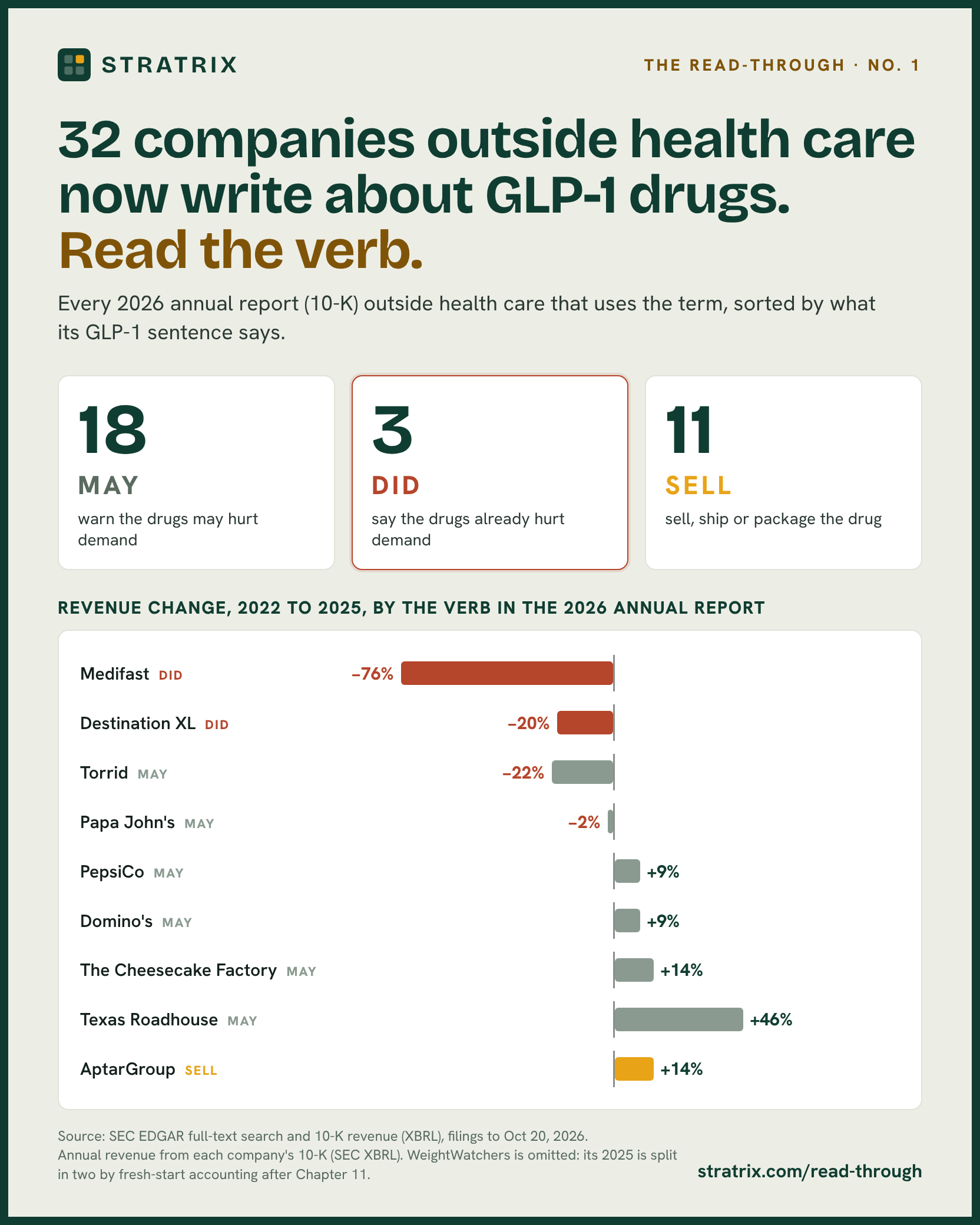
So far in 2026 it is 32.
The list reads like a census of the American appetite. PepsiCo, Domino's, Papa John's, Texas Roadhouse, The Cheesecake Factory, Flowers Foods and the nut packer John B. Sanfilippo & Son. Brown-Forman, Molson Coors and Constellation Brands. Two clothing chains for larger bodies, Torrid and Destination XL. And a life insurer, American National, whose worry is the reverse of everyone else's. The drugs, it writes, "may increase overall health, longevity and life expectancy," in which case "the duration of payments made under certain of our annuity products would be extended beyond our actuarial assumptions." It is the only company on the list whose risk is that the drug works.
Count the mentions and you get a trend. Read them and you get three groups, sorted by verb.
May
Eighteen of the 32 warn. Their verb is "may." Texas Roadhouse and The Cheesecake Factory use nearly the same sentence: GLP-1 agonists "may shift consumer preferences." Flowers Foods, the bread baker, says the drugs "may impact demand for our products."
This is less alarming than it sounds, and the reason is mechanical. The risk-factor section of an annual report is where a company's lawyers list everything that could go wrong, so that if it does, no shareholder can say nobody warned them. Adding a sentence costs nothing; leaving one out can cost a lawsuit. So a worry that fills the financial press turns up in the risk factors a year or so later, everywhere at once, in nearly identical words. Identical sentences are not evidence of damage. They are evidence of lawyers reading the same newspapers.
The executives have said as much on their calls. PepsiCo's chief executive, Ramon Laguarta, said in October 2023: "So far, the impact is negligible in our business." McDonald's chief executive, Chris Kempczinski, said in February: "We don't yet see evidence of it really having a material impact on our business." The revenue lines agree, so far. From 2022 to 2025, revenue rose 46% at Texas Roadhouse, 9% at Domino's and 9% at PepsiCo.
The best outside measure of the dent comes from Cornell researchers writing in the Journal of Marketing Research, who tracked what households actually bought. Within six months of starting a GLP-1 drug, households cut grocery spending by an average of 5.3%, and spending at fast-food restaurants, coffee shops and other limited-service eateries fell by about 8%. Savory snacks fell about 10%. That is a real dent in each customer. Spread across a country where 12% of adults told KFF last November that they are currently taking one of the drugs, it is a margin problem. It is not yet a business-model problem.
Did
Three companies have changed tense.
| Medifast did | −76% | |
|---|---|---|
| Destination XL did | −20% | |
| Torrid may | −22% | |
| Papa John's may | −2% | |
| PepsiCo may | +9% | |
| Domino's may | +9% | |
| The Cheesecake Factory may | +14% | |
| Texas Roadhouse may | +46% | |
| AptarGroup sell | +14% |
Annual revenue from each company's 10-K (SEC XBRL). WeightWatchers is omitted: its 2025 is split in two by fresh-start accounting after Chapter 11. Source: SEC EDGAR.
Medifast sells Optavia meal plans through independent coaches, and its annual report is blunt: the "favorably perceived and easier to use weight loss medications, such as GLP-1s," have "reduced and may further reduce demand for our services and products." The coaches are the business, and the coaches have been leaving since the first quarter of 2023. At the end of 2025 there were 16,100 active earning coaches, down 40.6% in a year, a decline the company ties in part to the "rapid adoption of GLP-1 medications for weight loss." Revenue went from $1.6 billion in 2022 to $386 million in 2025.
WeightWatchers, a community "built over six decades," as its filing puts it, wrote in its 2024 annual report that "a rapid proliferation of GLP-1 and other medications" had "negatively impacted our Behavioral business." Revenue had fallen from $1.41 billion in 2019 to $786 million. In March 2023 it had bought Sequence, a telehealth prescriber, for a net $106 million. In February 2024 its best-known director, Oprah Winfrey, said she would not stand for re-election and would donate her stake to the National Museum of African American History and Culture. On May 6, 2025, the company filed for Chapter 11 to eliminate $1.15 billion of debt. The old shareholders kept 9% of the new equity.
Destination XL, the big-and-tall menswear chain, wrote the most honest sentence on the list: "While difficult to quantify, we believe that the increased use of GLP-1 medications also negatively impacted demand." Its revenue fell from $546 million in 2022 to $435 million in 2025. Torrid, the other clothing chain, still says "may," though its revenue fell 22% over the same years. Lawyers are not obliged to change tense first.
Notice what the three have in common. It is not calories. Medifast and WeightWatchers sell fewer calories, by design. They sell the same job the drug does, losing weight, and the drug does it with less effort. Destination XL sells to the body the drug changes. Pizza sells dinner, and a GLP-1 patient still eats dinner, only less of it. When a new product does your customer's job, your verb changes. When it only shrinks the portion, you get Darden's 50 basis points.
The market has drawn the same line. Suppose you had put a dollar into Medifast and a dollar into an S&P 500 fund at the end of 2022, dividends reinvested. Today the Medifast dollar is worth about a twentieth of the index dollar. The "may" group is all over the place: The Cheesecake Factory has done nearly twice as well as the index, Papa John's about an eighth as well. A spread that wide is not one drug.
The other side of the trade
Every trade has another side. The other eleven filers are on the drug's side of it: they sell, dispense, ship, package or study it, or plan to. GoodRx, a pharmacy-automation company, a health-account provider, a cold-chain logistics firm, an aesthetics practice owned by Graham Holdings. The quietest winner is AptarGroup, which makes stoppers and plungers for vials and syringes: "Injectables core sales increased 11% driven by robust GLP-1 component sales."
Two of the three companies that changed tense have crossed over. WeightWatchers' clinical tier offers a clinician who can prescribe "both the oral and injectable versions of GLP-1s." Medifast sells an "OPTAVIA GLP-1 Nutrition Support Plan." When the drug takes your job, you sell the side dish.
Why the tense matters this quarter
Part of the case for "may" was price. An injection that costs hundreds of dollars a month limits who takes it. That changed this year. Novo Nordisk's Wegovy pill went on sale on January 5 at $149 a month for the starting dose. Eli Lilly's Foundayo pill followed on April 9, also from $149, and eligible Medicare Part D patients may get it for $50 a month beginning July 1. The third quarter, whose results are arriving now, is the first with both pills on sale and Medicare paying.
Darden says usage has been "relatively stable since July 2025." Perhaps. The next round of annual reports, filed early next year, will show whether anyone else has changed tense.
The rule
When a new threat sweeps through the risk factors, do not count the mentions. Read the verb. "May" is written by a lawyer. "Did" is written by an accountant. And the tense changes first not at the companies that sell what the new thing reduces, but at the companies that sell what it replaces. For pizza, beer and potato chips this winter, the read-through is simple: watch for the first "did."
Sources
- SEC EDGAR full-text search, form 10-K, "GLP-1", 2019 to October 20, 2026
- SEC XBRL company facts: annual revenue
- Darden Restaurants Q1 fiscal 2027 earnings call, September 24, 2026 (transcript, The Motley Fool)
- Medifast, 10-K for 2025
- WW International, 10-K for 2024
- WW International, 10-K for 2025
- WW International, Sequence acquisition release, March 6, 2023
- WW International, board transition release, February 28, 2024
- WW International, Chapter 11 release, May 6, 2025
- Destination XL Group, 10-K for fiscal 2025
- Torrid Holdings, 10-K for fiscal 2025
- AptarGroup, 10-K for 2025
- American National Group, 10-K for 2025
- Texas Roadhouse, 10-K for 2025
- The Cheesecake Factory, 10-K for 2025
- Flowers Foods, 10-K for 2025
- Fortune, "Pepsi CEO: weight-loss drugs' impact negligible", October 11, 2023
- Yahoo Finance, McDonald's prepares for wider GLP-1 adoption, February 15, 2026
- Cornell Chronicle, "Ozempic is changing the foods Americans buy", December 19, 2025 (on Hristakeva and Liaukonyte, Journal of Marketing Research)
- KFF Health Tracking Poll, November 14, 2025
- Novo Nordisk, Wegovy pill US launch, January 5, 2026
- Eli Lilly, Foundayo available in the US, April 9, 2026 (PR Newswire)
- Market comparisons: derived from market data (Tiingo), total return with dividends reinvested, December 30, 2022 to October 20, 2026; ratios only
Not investment advice. The Read-Through does not recommend buying or selling any security. Market comparisons are total-return ratios derived from market data, rounded.