Last Thursday, Intuit agreed to sell Mailchimp to Bending Spoons for $3.68 billion. In 2021, Intuit had agreed to pay about $12 billion for it. That is the news everyone is talking about.
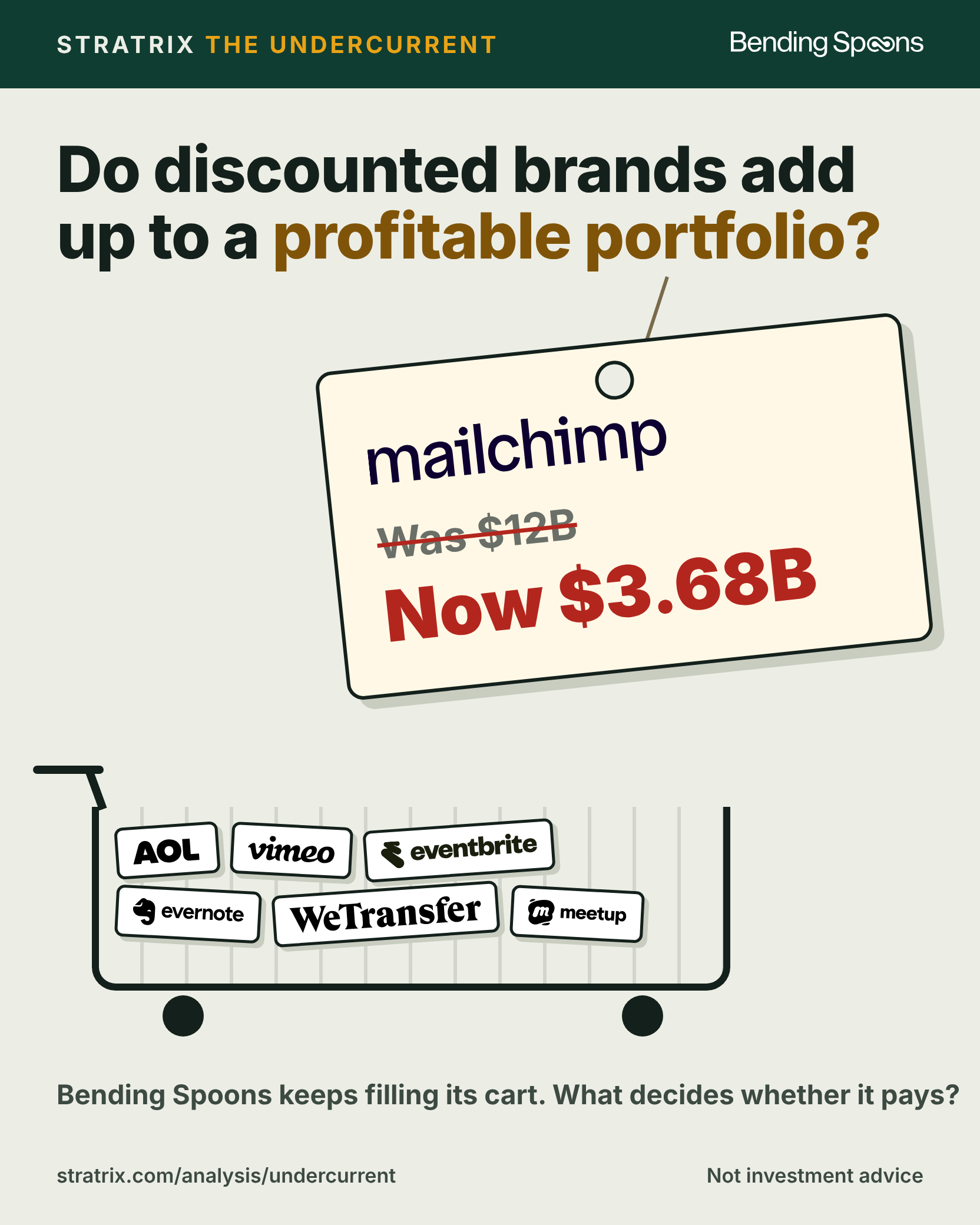
Logos are the companies' own. Source: Intuit's filings of September 13, 2021 and November 19, 2026.
The better question sits behind it. Can a collection of out-of-favor brands, bought cheaply, become a profitable company that lasts? It can, but only when the new owner makes the brands better, not just cheaper to run. Cutting costs raises profit one time. After that, more profit has to come from products that more people want.
| Mailchimp, Intuit's 2021 price | $12.00B |
|---|---|
| Mailchimp, Bending Spoons' 2026 price | $3.68B |
| Vimeo, Bending Spoons' 2025 price | $1.38B |
Agreed prices, in billions of dollars. Intuit's 2021 price was about $12 billion in cash and stock; the 2026 price is a base price subject to adjustments. Source: Intuit's filings of September 13, 2021 and November 19, 2026; Vimeo's filing of September 10, 2025.
Four owners show how that plays out: Bending Spoons, which is making the bet in public right now; Berkshire Hathaway, which is backing Bending Spoons and once took a large write-down on famous brands at Kraft Heinz; Constellation Software, which says it keeps what it buys; and Broadcom, which raised what VMware's customers pay. And Canva's own restructuring this month shows that a company can make deep cuts without being sold.
The buyer says what it does
Bending Spoons is an Italian software company that went public in July. Its prospectus puts the plan in one sentence: "acquire digital businesses, implement deep transformations and ongoing optimizations to sustainably expand earnings, and reinvest in additional acquisitions."
The middle step, the transformation, is the one this story turns on, and the prospectus is plain about what it usually looks like: "When we acquire a business, we typically restructure it significantly, often transitioning to a much smaller, more talent-dense organization." Among its costs, the prospectus lists separation packages offered to staff in the reorganizations of AOL, Eventbrite and Vimeo.
The pace has picked up with each year. The company closed one acquisition in 2023, five in 2024, six in 2025 and two in the first quarter of 2026. A year ago today, it completed the purchase of Vimeo at $7.85 a share in cash, a deal valued at about $1.38 billion. Mailchimp, at $3.68 billion, is a much bigger purchase. Intuit expects the sale to close in early 2027.
Show the numbers
| Acquisitions closed | |
|---|---|
| 2023 | 1 |
| 2024 | 5 |
| 2025 | 6 |
| First quarter of 2026 | 2 |
Acquisitions closed in each period. Source: Bending Spoons S.p.A., final prospectus (June 30, 2026).
The deals are getting more frequent and larger. A buyer that keeps needing bigger purchases to grow depends on a steady supply of brands that other owners want to sell. Mailchimp is evidence that the supply exists: its seller took less than a third of what it once agreed to pay. Whether the buyer can do more with it than the seller did is a separate question, and the one that decides the profit.
Revenue tripled. Profit went the other way.
Here is what buying brands at speed looks like in the books. Revenue went from $387 million in 2023 to $671 million in 2024 and $1.31 billion in 2025, more than triple in two years. Net income went from $161 million to $89 million to a loss of $0.2 million.
| Revenue, 2023 | $387M | |
|---|---|---|
| Revenue, 2024 | $671M | |
| Revenue, 2025 | $1,306M | |
| Net income, 2023 | $161M | |
| Net income, 2024 | $89M | |
| Net income, 2025 (a loss of $0.2 million) | −$0.2M |
In millions of dollars, from the prospectus. The 2025 figure is a loss of $0.2 million, too small to show at this scale. Source: Bending Spoons S.p.A., final prospectus (June 30, 2026).
The latest quarter says where the growth comes from. Revenue in the first quarter of 2026 rose 132% from a year earlier, "primarily driven by acquisitions." The company names the businesses it added: AOL, Eventbrite, Harvest, MileIQ and Vimeo.
This does not mean the plan is failing. Restructuring costs often show up before the savings do, and the first quarter of 2026 showed a profit of $27 million, against a loss of $112 million a year before. But so far, most of the revenue growth has come from buying companies. Whether those companies earn more under their new owner has not yet shown up in the numbers, and each new purchase adds another business to reorganize. That is why a cost cut, however well done, is not enough. It improves a brand's profit once. To keep earning more, a company has to buy again, or the brand has to grow.
Berkshire backs Bending Spoons, and it once owned Kraft Heinz
Berkshire Hathaway put $600 million into the July offering and $330 million more in October, which brought its stake to 4%. Bending Spoons' chief executive called Berkshire "a longstanding inspiration."
Berkshire has also seen famous brands lose value. In 2015, when Kraft and Heinz merged, Berkshire and 3G Capital put an additional $10 billion into the new company. In February 2019, Kraft Heinz recorded non-cash impairment charges of $15.4 billion, on goodwill and on intangible assets, "primarily the Kraft and Oscar Mayer trademarks."
That last phrase matters. Part of the charge was on the brands themselves: the company was saying that two of its best-known trademarks were worth less than the value it had carried them at. A brand bought or merged at a good price can still lose value when fewer customers want it.
| Kraft Heinz | Bending Spoons | |
|---|---|---|
| Berkshire's money in | An additional $10 billion with 3G Capital, 2015 | $600 million in July 2026, $330 million in October |
| What the company does | Runs famous food brands | Buys digital businesses and restructures them |
| What happened next | $15.4 billion of impairment charges in 2019, primarily the Kraft and Oscar Mayer trademarks | Too early to tell |
Berkshire's stake in Bending Spoons is 4%. Source: Kraft Foods Group, Form 425 (March 25, 2015); Kraft Heinz, Form 8-K (February 21, 2019); Bending Spoons, Form 6-K (October 14, 2026).
Two other ways to own brands others gave up
Constellation Software buys vertical-market software companies and, in its own words, "operates them indefinitely, respecting their culture, leadership, and autonomy." That is close to the opposite of a restructuring. Its words point to a different bet: that each business's own team knows how to make it better, and that a patient owner should leave them to it. Because it keeps what it buys and leaves the teams in place, its profit over time has to come from those businesses doing better, not from a single round of cuts.
Broadcom took a third route with VMware. Broadcom ended perpetual licenses for products including vSphere, vSAN and NSX within weeks of closing, and expected about $8.5 billion of added operating earnings (pro forma EBITDA) from VMware within three years. The tools were licensing terms and price. That can earn a great deal, but it depends on customers staying, and by itself it does not make the product better.
| Owner | What it does after buying | Where the next dollar of profit comes from |
|---|---|---|
| Bending Spoons | Restructures each business into "a much smaller, more talent-dense organization" | Lower costs, then the next purchase |
| Broadcom (VMware) | Ended perpetual licenses within weeks of closing | Licensing terms and price |
| Constellation Software | Says it "operates them indefinitely, respecting their culture, leadership, and autonomy" | The businesses getting better |
Each company's own words or filings. Source: Bending Spoons' prospectus; Broadcom's VMware filings; Constellation Software's acquisition criteria.
Set side by side, the owners differ in one thing: where the next dollar of profit comes from. For Bending Spoons it comes from smaller organizations and more purchases. For Broadcom, from higher prices. For Constellation, from the businesses getting better under a patient owner. Only the last keeps working year after year without another purchase or another price rise.
How to tell whether a buyer is making a brand better
The test is simple to state: a year after the sale, do the brand's customers get more than they got before? There are only a few ways for a brand to earn more. It can charge more for the same thing, which is Broadcom's route. It can run with fewer people, which is Bending Spoons' first move. Or it can become a product more people want, which is the only one of the three that does not run out.
Stratrix's framing. Source: Stratrix.
The figures Bending Spoons has published do not settle which of these is happening inside it. Its prospectus says acquisitions were the main driver of revenue growth, so those figures do not show whether AOL, Eventbrite or Vimeo are growing on their own. Mailchimp will not join the group until the deal closes, expected in early 2027. The honest position today is that the bet is open, and that the evidence to watch is organic growth in the brands it already owns, not the size of the next purchase.
Canva shows a company can make the cuts itself
On November 4, Canva told its staff that a restructuring affects 1,271 people, about 22% of its workforce, as The Register reported. That figure counts everyone affected, not confirmed job losses.
The point for this story is that a company can restructure itself. Any management team can make these cuts without waiting for a buyer. If the main thing a new owner brings is a smaller payroll, a seller can make much of that saving first, and the sale price should reflect it. What a buyer can bring that the seller cannot is a better product, a better route to customers, or more patience.
What to do on Monday
If you run a mature product, ask what a buyer would cut. Then ask whether you could cut it first, and what you would build with the money.
If you are the buyer, or the board approving one, ask a different question: who makes this product better in the third year, and what do they need from us? If the answer is nobody, the plan is a cost cut, and a cost cut pays back once.
Buying cheap is the easy part. Keeping the brands growing decides whether it pays.
Get The Read-Through
Two short analyses a week, Wednesday and Friday: the week’s news, read across the market, every figure sourced. Free.
Share this analysis
Sources
- Intuit Inc., Form 8-K (November 19, 2026): sale of Mailchimp to Bending Spoons
- Bending Spoons S.p.A., final prospectus (June 30, 2026)
- Bending Spoons S.p.A., Form 6-K Exhibit 99.1 (October 14, 2026): Berkshire Hathaway investment
- Vimeo, Inc., Form 8-K Exhibit 99.1 (September 10, 2025)
- The Kraft Heinz Company, Form 8-K Exhibit 99.1 (February 21, 2019)
- Kraft Foods Group, Form 425 Exhibit 99.1 (March 25, 2015)
- Constellation Software, acquisition criteria
- The Register, Canva restructuring report (November 4, 2026)
Not investment advice. The Undercurrent does not recommend buying or selling any security. Figures come from the companies' own filings and press releases and from the outlet named; rounded figures and the chart are our arithmetic. No market prices are used.
Tools to try
- Ansoff move finderFramework: Ansoff Matrix
- Business model canvas builderFramework: Business Model Canvas
- Change readiness checkFramework: Kotter's 8-Step Change Model
- Five Forces scorerFramework: Porter's Five Forces
- SMART goal builderFramework: SMART Goals
- SWOT builderFramework: SWOT Analysis
More from Stratrix
“What did the decision you did not take actually cost?”
One decision per pack: the framework, a working model, the sourced cases and the board material.
See the pack — $499 →Strategic Decisions
The big calls companies keep facing, told through the 819 companies on record that made them.
24 decisionsFind your decision →Weekly email
Stratonomics, every Tuesday
One data story every Tuesday: what happened, what it means, and the figures you can quote. Free.
Test a decision, free
Set a live decision against the companies that made it before you.
AcquisitionsThe Distance TestDivestituresThe Divestiture TestDiversificationThe Diversification TestMake or buyThe Make-or-Buy Test