Licensed to an organization: checkout asks for the company the purchase is for, its website, and an email address to deliver the files to. A work address is best for the license record; a personal one is accepted. Digital download. All sales are final: no refunds or returns. Each format can be downloaded 3 times, and the links stay valid for 30 days. If you need more, reply to your confirmation email and we will sort it out.
A plan says the company will grow profit at some rate. The businesses it already owns produce some of that. The difference has to be bought, with money, from people who do not have to sell — and the size of that bill is fixed the day the rate is announced, before anybody has looked at a single target. Almost no acquirer states it, because a growth rate does not look like a purchase order. This pack splits reported growth into the part that was bought and the part that was grown, prices the buying as a purchase of earnings at a multiple rather than as a transaction with a value, and sets the spread against what the same money would retire of your own shares — a comparison settled entirely by whether the multiple you pay sits below the one you trade at. Then it answers the question the spread never asks: the year the balance sheet stops funding the buying, from four figures the company already has. It stops on four conditions: nobody has said what the company trades on, nobody has said what it pays for earnings, nobody has stated the plan's growth requirement, and nobody has said where the debt stops.
What is the Acquisition Machine Strategy Pack
The Acquisition Machine Strategy Pack is a complete decision-support kit for one question: how much of your plan's growth do you have to buy, what does the buying earn you, and how long can you keep doing it? It is built around one organizing claim: a serial acquirer's engine is the gap between what the market pays for its earnings and what it pays for somebody else's. Sixteen files carry it: the foundations, a concept deck, a scored decision wizard, a machine model blank and worked, the moves at each position, nine sourced acquirers, a fit worksheet, a roadmap template, a practitioner manual, a field checklist, and an orientation page.
The test that runs through every file
A serial acquirer's engine is the gap between what the market pays for its earnings and what it pays for somebody else's, which is arbitrage rather than operations and stops when either multiple moves. It is the argument in the deck, it becomes the wizard’s axes, it drives the model’s inputs, and it reappears as lines on the checklist. That is what makes 16 files a product rather than 16 documents.
The model resolves to one number you can negotiate with: The spread — what the market pays for your earnings, less what you pay for theirs. It ships blank and worked, and every input is a named cell rather than a figure buried inside a formula, so the number arrives with its assumptions attached rather than on its own authority.
Why a serial acquirer's growth rate is a commitment to spend
A plan says the company will grow profit at some rate. The businesses it already owns produce some of that. The difference has to be bought, with money, from people who do not have to sell — and the size of the bill is fixed the day the rate is announced, before anybody has looked at a single target.
This pack makes that bill visible and prices it. It splits reported growth into the part that was bought and the part that was grown, prices the buying as a purchase of earnings at a multiple rather than as a transaction with a value, sets the spread against what the same money would retire of your own shares, and computes the year the balance sheet stops funding it.
What is in the Acquisition Machine Strategy Pack
- Foundations. The framework: why a growth rate is a commitment to spend, where the money comes from, the buyback comparison, and the four halts.
- Concept deck. Twenty-two slides for a board or planning session, with nine sourced acquirers and what each does not establish.
- Decision wizard. Eight scored questions returning the band, the weakest answer, and either of the two halt conditions.
- Machine model. Eleven candidate multiples paid across the columns, the spread against the buyback alternative, and the year the balance sheet stops funding the plan.
- Strategies and tactics. The moves at each of the four positions, what to do when the model halts, and four ways to make the next acquisition decision cheaper.
- Case studies. Nine sourced acquirers — one that paid 98% of $34.2bn in its own shares, one that booked $27.7bn of negative goodwill on the day it closed, and one that bought a lawsuit it could read in advance.
- Fit worksheet. The single page of record: the two multiples, the split of bought from grown, the spread, and the year.
- Roadmap template. Five phases with gates and owners, the assumptions register, a trigger and a quarterly reporting line.
- Practitioner manual. Splitting bought from grown, pricing deals as purchases of earnings, the board paper, six failure modes and their indicators.
- Field checklist. The one-pager that survives outside the binder.
- About the package. What each file does and the order in which to run them.
Who the Acquisition Machine Strategy Pack is for
A chief financial officer who suspects the plan's growth rate is a spending commitment no one has priced; a chief executive who has never seen how much of the company's performance was purchased; a board member holding a deal paper with no alternative in it; a corporate development team that would rather know its own record than defend it; a private equity owner assessing a platform's buy-and-build thesis; and the adviser who would otherwise start from a blank page. It is worth buying when a real decision is in front of you. It is not worth buying to read.
An honest note on fit
This is a kit for running a decision, not a research report and not a valuation of any target. Worked examples use an explicitly fictional acquirer with numbers tuned to teach rather than to flatter. In the worked case the plan requires nine percent growth against three percent organic, which commits the company to buying $74.4m of profit a year at a cost of $818.4m; the spread is $446.4m a year and genuinely valuable; and the balance sheet funds about 4.2 more years of it against a plan that runs five.
Two limits are stated on the page rather than worked around. The pack prices the machine and not any deal in it — integration, synergies, the people who leave and what the acquired businesses do afterward are real, frequently decisive, and not in this arithmetic. And it cannot forecast your own multiple, which is the input the whole engine runs on and the one no one controls, which is why the model sweeps the price you pay rather than asserting it.
This decision, in two minutes
Short videos on companies that faced it, built from the casebooks this pack draws on.

The free guide to this decision
How companies ran this decision, case by case, and the method the pack is built on. Read the guide →
Questions about the Acquisition Machine Strategy Pack
- What number does the model produce?
- Four. How much of the plan's growth has to be bought and what that costs a year at the multiple you have been paying; the spread between your own multiple and the one you pay; what the same money would retire of your own earnings instead; and the year the balance sheet stops funding it. The Model tab sweeps candidate multiples paid rather than periods, so the answer is a column you can point at — and the row turns over at exactly the column that equals your own multiple.
- Isn't acquiring just a normal way to grow?
- Yes, and this pack does not argue otherwise. What it argues is that a price should be stated as a multiple of earnings rather than as a transaction value, because a price without a denominator cannot be compared with another deal, with a buyback, or with the company's own record.
- What if the model says the buying creates a lot of value?
- Then it says so, and often it does. Where a company's currency is expensive and it buys cheaply, the spread is real money. The pack then asks the two questions the spread does not: how long the balance sheet funds it, and what happens if your own multiple falls.
- Are the case studies real companies?
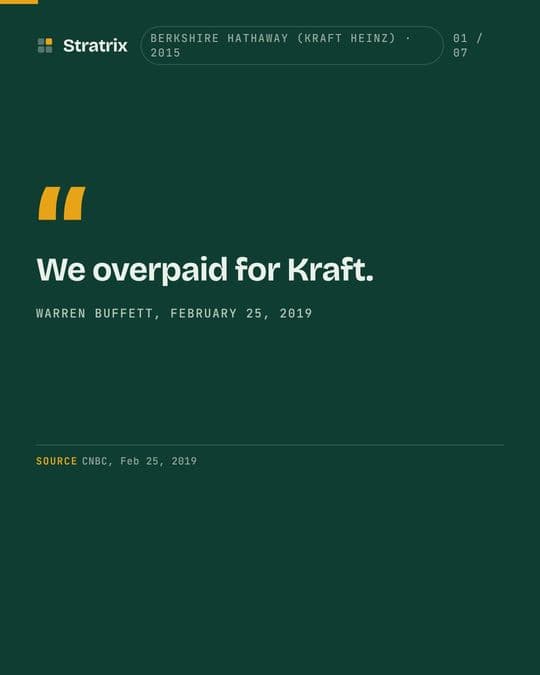
- Yes. Nine sourced acquirers: Cisco, Broadcom, Exxon and Pioneer, AB InBev, Dell and EMC, Kraft Heinz, Bayer and Monsanto, UBS and Credit Suisse, and Salesforce. Each is dated, read through what the growth was bought with and what was paid for the earnings, and each states what its evidence does not establish. No disclosure separates the effect of a multiple from everything else moving in the same period, and none of the figures is presented as doing so. The worked model, wizard, and worksheet use an explicitly fictional acquirer, labeled as such on every file.
- We only buy occasionally. Is this still useful?
- Yes. The split of bought from grown, your own multiple on one profit measure, and the multiple you paid last time are worth having as standing documents — because an occasional acquirer with those three can price a proposal in an afternoon and decline a bad one before the advisers are appointed.
- Is this a subscription?
- No. One payment, one download, sixteen files, yours to keep and to use inside your organization under the license included in the pack.
- What is the Acquisition Machine Strategy Pack?
- The Acquisition Machine Strategy Pack is a decision-support kit for one question: How much of your growth are you buying, and at what spread? It contains 16 files — foundations, concept deck, decision wizard, machine model, strategies and tactics, case studies, fit worksheet, roadmap template, practitioner manual, field checklist, about the package — built around a single organizing test: a serial acquirer's engine is the gap between what the market pays for its earnings and what it pays for somebody else's, which is arbitrage rather than operations and stops when either multiple moves. It is what a leadership team uses to run the decision and leave a record of what they assumed, rather than a report about the topic.
- Who is the Acquisition Machine Strategy Pack for?
- Anyone who has to make this call and answer for it: an operator or owner facing the decision, the executive team running it, the board or investor testing the reasoning, or an adviser who would otherwise build the framework from a blank page. It is worth buying when a real decision is in front of you. It is not worth buying to read.
- What is in the Acquisition Machine Strategy Pack?
- 16 files in Word, PDF, PowerPoint and Excel: Foundations (Word + PDF) — The framework: why a growth rate is a commitment to spend, where the money comes from, the buyback comparison, and the four halts. Concept deck (PowerPoint + PDF) — Twenty-two slides for a board or planning session, with nine sourced acquirers and what each does not establish. Decision wizard (Excel) — Eight scored questions returning the band, the weakest answer, and either of the two halt conditions. Machine model (Excel, blank and worked) — Eleven candidate multiples paid across the columns, the spread against the buyback alternative, and the year the balance sheet stops funding the plan. Strategies and tactics (Word) — The moves at each of the four positions, what to do when the model halts, and four ways to make the next acquisition decision cheaper. Case studies (Word) — Nine sourced acquirers — one that paid 98% of $34.2bn in its own shares, one that booked $27.7bn of negative goodwill on the day it closed, and one that bought a lawsuit it could read in advance. Fit worksheet (Word, blank and worked) — The single page of record: the two multiples, the split of bought from grown, the spread, and the year. Roadmap template (Word) — Five phases with gates and owners, the assumptions register, a trigger and a quarterly reporting line. Practitioner manual (Word + PDF) — Splitting bought from grown, pricing deals as purchases of earnings, the board paper, six failure modes and their indicators. Field checklist (PDF) — The one-pager that survives outside the binder. About the package (PDF) — What each file does and the order in which to run them.
- How is the Acquisition Machine Strategy Pack delivered?
- As a single download of all 16 files, immediately after payment, with the same link sent by email. It can be downloaded 3 times and the link is valid for 30 days. There is nothing to install and no account to keep.