Licensed to an organization: checkout asks for the company the purchase is for, its website, and an email address to deliver the files to. A work address is best for the license record; a personal one is accepted. Digital download. All sales are final: no refunds or returns. Each format can be downloaded 3 times, and the links stay valid for 30 days. If you need more, reply to your confirmation email and we will sort it out.
A take-private is the purchase of every public share at a premium, by the people who run the company, its founding family, or a fund, so that the company can do something the market would punish. The price is paid mostly with debt, and the debt goes onto the company being bought. The room argues in two units, and neither is the one the debt is paid in: the committee negotiates the premium in points and the lenders size the debt in turns, while the reason for leaving exists as a sentence in the board deck. Nordstrom's record gives it in four words, "privacy buys patience," and no figure. This pack turns the decision into arithmetic. The unaffected market value at the premium, plus the debt refinanced, plus the fees, less the equity the buyers put in, is the debt to get there; at the lenders' rate it demands a figure a year. What the company earns, less what the plan costs a year, is what the plan leaves. The room between them is the decision, and two distances follow: the break-even plan cost, the most the plan can cost a year before the debt is not served, and the break-even premium, the most the buyers can pay before the debt takes the plan. Nine sourced decisions hold the frame: five listed companies that left, two that defaulted within six years, one that came back, two approaches declined on the buyers' financing, and two companies that were never listed, read beside them. It stops on two halts: no one has priced what the company would do out of the light, and no one has assembled what the debt would demand a year.
What is the Take-Private Strategy Pack
The Take-Private Strategy Pack is a complete decision-support kit for one question: what is worth doing out of the light, and what does the debt to get there demand? It is built around one organizing claim: the plan a company leaves the market to run and the debt that takes it there want the same dollars, in the same years, and almost no room prices both. Sixteen files carry it: the foundations, a concept deck, a scored decision wizard, a privatization model blank and worked, the moves at each reading, nine sourced decisions, a fit worksheet, a roadmap template, a practitioner manual, a field checklist, and an orientation page.
The test that runs through every file
whether the plan the company would run out of the light is worth more than the debt that takes it there demands, on the earnings the plan leaves, in the years the plan runs. It is the argument in the deck, it becomes the wizard’s axes, it drives the model’s inputs, and it reappears as lines on the checklist. That is what makes 16 files a product rather than 16 documents.
The model resolves to one number you can negotiate with: The break-even plan cost — the most the plan can cost a year before the debt is not served. It ships blank and worked, and every input is a named cell rather than a figure buried inside a formula, so the number arrives with its assumptions attached rather than on its own authority.
Why the take-private decision is priced by the plan, not the leverage
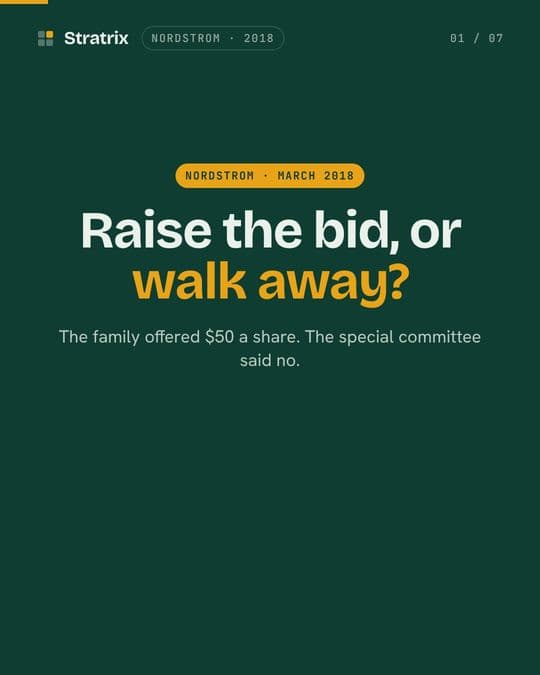
Because the multiple is the wrong unit, and the room argues in it. The committee negotiates the premium in points; the lenders size the debt in turns; and the reason for leaving is a sentence in the board deck. Nordstrom's record gives it in four words and no number. Walgreens' gives it as rescue. Dell's gives it as a contradiction the company would no longer have to narrate. In most companies the plan exists as a rationale, and the interest bill exists on the buyers' side of the table, so no one in the boardroom has assembled either.
This pack turns that into arithmetic. The unaffected market value at the premium, plus the debt refinanced, plus the fees, less the equity the buyers put in, is the debt to get there; at the lenders' rate it demands a figure a year. What the company earns, less what the plan costs a year, is what the plan leaves. The room between them is the decision, and two distances follow from it: the break-even plan cost, which is the most the plan can cost before the debt is not served, and the break-even premium, which is the most the buyers can pay before the debt takes the plan.
The finding, in most rooms, is the opposite of the instinct: the room believes the danger is the debt and the point is the plan, and the page says the plan is the thing that goes, because after the price is agreed it is the only one of the three things still free to move. Southland paid $77 a share against a $70 valuation for a defense and defaulted in three years. Dell left at $13.88 with a plan, borrowed $45.9 billion more to run it, and came back in five.
What is in the Take-Private Strategy Pack
- Foundations. The framework: why leaving the market is a purchase the company pays for itself, the arithmetic, the four endings that actually happen, and the halts.
- Concept deck. Twenty-four slides for a board or a special committee, with nine sourced decisions and what each does not establish.
- Decision wizard. Eight scored questions returning the band, the weakest answer, and either of the two halt conditions.
- Privatization model. Eleven candidate plan costs across the columns, from nothing to the whole of the earnings, and the break-even premium that decides it.
- Strategies and tactics. The moves at each of the four readings, what to do when the model halts, and four ways to make the next take-private cheaper to judge.
- Case studies. Nine sourced decisions: five that left, two declined on the financing, and two companies that were never listed, read beside them for the debt and the price of staying out.
- Fit worksheet. The single page of record: the unaffected value and the premium, what the plan costs, what the company earns, what the debt demands, the equity in writing, and the two break-evens.
- Roadmap template. Five phases with gates and owners, the assumptions register, a reporting change and a periodic review line.
- Practitioner manual. The unaffected value, pricing the plan, the lenders' earnings figure, assembling the debt, the equity in writing, the committee's paper, six failure modes.
- Field checklist. The one-pager that survives outside the binder.
- About the package. What each file does and the order in which to run them.
Who the Take-Private Strategy Pack is for
A founder or a family with a plan the market has punished twice and a sponsor at the door; a special committee negotiating a premium in points without a bill; a chief financial officer being asked whether five and a half turns is normal; a chief executive who knows the plan exists as a sentence; a board member reading an offer with a multiple and no demand beside it; a private equity operating partner sizing the equity check against a plan the operators have not signed; and the adviser who would otherwise start from a blank page. It is worth buying when a real approach is in front of you. It is not worth buying to read.
An honest note on fit
This is a kit for running a decision, not a research report and not a forecast. Worked examples use an explicitly fictional company with numbers tuned to teach rather than to flatter. In the worked case a company worth $1.8bn before the approach, earning $330m a year, is offered a 35 percent premium and borrows $1.82bn to leave; the room called 5.5 turns normal. The plan it is leaving to run costs $190m a year for three years and leaves $152m against a demand of $163.8m, so the plan does not fit, the most it can cost is $178.2m, and the most the buyers can pay is 27.7 percent. The seven points the committee negotiated up are the plan, and the reading is more equity, a lower premium, or a smaller plan, with the third defeating the purpose of leaving.
The framework-to-evidence ratio is high and stated: no sourced case prices the plan a company left the market to run, and none states the debt and the equity of a take-private together with what the company earned afterward, so the plan-against-demand arithmetic is Stratrix framework throughout, and every page that carries it says so. Seven of the nine cases are strictly on the decision and two are read beside it, labeled as borrowed. Four limits are stated on the page rather than worked around. The model does not forecast what the plan will earn once it is done — that figure is your own judgment, and the Model tab sweeps the plan's cost precisely because no one can settle it in advance. It prices the debt's demand as interest alone. It holds the rate flat for the plan years. And it says nothing about what leaving costs beyond the arithmetic: the shareholders who wanted to stay, the reporting a private company still owes its lenders, and the exit a sponsor will need on a clock of its own.
This decision, in two minutes
Short videos on companies that faced it, built from the casebooks this pack draws on.
Questions about the Take-Private Strategy Pack
- What numbers does the privatization model produce?
- Two headlines and thirteen supporting rows. The break-even plan cost is the most the plan can cost a year before the debt demands more than the company earns; the break-even premium is the most the buyers can pay over the public price before the debt demands more than the plan leaves. Around them: the price paid, the debt to get there and its turns, what the debt demands a year, what the company earns in the plan years, the room between them, the room after the plan, the premium in years of what the plan adds, the equity that would let the plan fit, what the plan years need beyond earnings, the buyers' equity against the price, and the debt against revenue. The Model tab sweeps the plan's cost from nothing to the whole of the earnings, and one row turns from Yes to No where the plan stops fitting inside the debt.
- How much debt can a take-private carry?
- Not a multiple, and that is the whole point of the pack. In the worked case a fictional company's 5.5 turns is inside what deals of this kind carry, and the plan it is leaving to run leaves $152m a year against a demand of $163.8m, so in each of three plan years it is $11.8m short. The most the plan can cost at that price is $178.2m against the $190m it needs, and the most the buyers can pay for that plan is 27.7 percent against 35 on the table.
- We do not know what the plan costs a year.
- Most companies do not, because the reason for leaving exists as a sentence in the board deck. It is a week with the budget and the operators, and the manual sets out the five places the figure hides. Until it exists the premium is being negotiated against a number no one has seen, and the model halts rather than pretending otherwise.
- Does this only apply to sponsor buyouts?
- No. It applies wherever every public share is bought at a premium with debt the company will carry: a founder's or a family's buyout, a management buyout with a sponsor, a sponsor's own bid, and a founder buying out the last outside holder to stay private. Four of the nine cases were led by the people running the company, and two of the nine were never listed at all.
- Are the case studies real companies?
- Yes. Nine sourced decisions: Dell, Southland, Macy's in 1986, Toys R Us, Nordstrom, Walgreens, Macy's in 2024, Subway, and Bloomberg. Each is dated, read through what was agreed and what the debt did, and each states what its evidence does not establish. Subway and Bloomberg were never listed and are read beside the seven, labeled as borrowed: one for what a buyer's debt looks like on a company once it is out, the other for what an owner pays to keep it out. The worked model, wizard, and worksheet use an explicitly fictional company, labeled as such on every file.
- Is this a subscription?
- No. One payment, one download, sixteen files, yours to keep and to use inside your organization under the license included in the pack.
- What is the Take-Private Strategy Pack?
- The Take-Private Strategy Pack is a decision-support kit for one question: What is worth doing out of the light, and what does the debt to get there demand? It contains 16 files — foundations, concept deck, decision wizard, privatization model, strategies and tactics, case studies, fit worksheet, roadmap template, practitioner manual, field checklist, about the package — built around a single organizing test: whether the plan the company would run out of the light is worth more than the debt that takes it there demands, on the earnings the plan leaves, in the years the plan runs. It is what a leadership team uses to run the decision and leave a record of what they assumed, rather than a report about the topic.
- Who is the Take-Private Strategy Pack for?
- Anyone who has to make this call and answer for it: an operator or owner facing the decision, the executive team running it, the board or investor testing the reasoning, or an adviser who would otherwise build the framework from a blank page. It is worth buying when a real decision is in front of you. It is not worth buying to read.
- What is in the Take-Private Strategy Pack?
- 16 files in Word, PDF, PowerPoint and Excel: Foundations (Word + PDF) — The framework: why leaving the market is a purchase the company pays for itself, the arithmetic, the four endings that actually happen, and the halts. Concept deck (PowerPoint + PDF) — Twenty-four slides for a board or a special committee, with nine sourced decisions and what each does not establish. Decision wizard (Excel) — Eight scored questions returning the band, the weakest answer, and either of the two halt conditions. Privatization model (Excel, blank and worked) — Eleven candidate plan costs across the columns, from nothing to the whole of the earnings, and the break-even premium that decides it. Strategies and tactics (Word) — The moves at each of the four readings, what to do when the model halts, and four ways to make the next take-private cheaper to judge. Case studies (Word) — Nine sourced decisions: five that left, two declined on the financing, and two companies that were never listed, read beside them for the debt and the price of staying out. Fit worksheet (Word, blank and worked) — The single page of record: the unaffected value and the premium, what the plan costs, what the company earns, what the debt demands, the equity in writing, and the two break-evens. Roadmap template (Word) — Five phases with gates and owners, the assumptions register, a reporting change and a periodic review line. Practitioner manual (Word + PDF) — The unaffected value, pricing the plan, the lenders' earnings figure, assembling the debt, the equity in writing, the committee's paper, six failure modes. Field checklist (PDF) — The one-pager that survives outside the binder. About the package (PDF) — What each file does and the order in which to run them.
- What number does the Take-Private Strategy Pack produce?
- The break-even plan cost — the most the plan can cost a year before the debt is not served. The model ships blank and worked, and every input is a named cell rather than a figure buried inside a formula, so the number you take into a room arrives with its assumptions attached and can be argued with rather than merely believed.
- How is the Take-Private Strategy Pack delivered?
- As a single download of all 16 files, immediately after payment, with the same link sent by email. It can be downloaded 3 times and the link is valid for 30 days. There is nothing to install and no account to keep.