

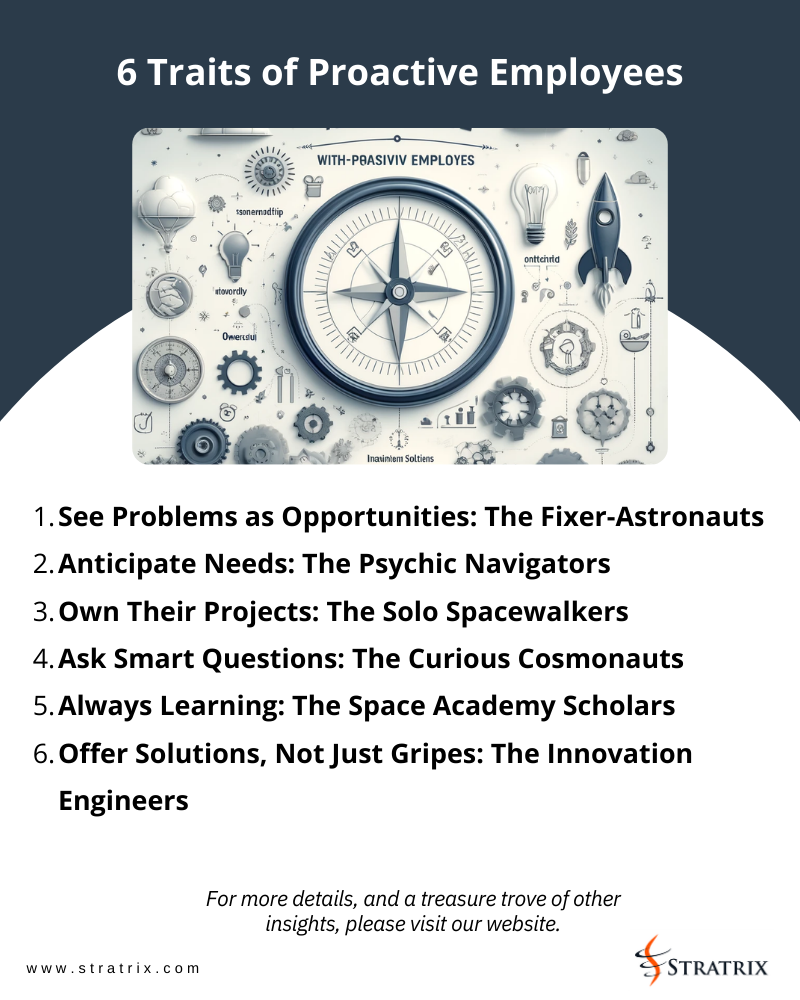
In the vast universe of the workplace, where stars of talent and skill constellations light up the corporate sky, proactive employees are like comets: rare, spectacular, and impossible to ignore. These are the individuals who don’t just do what’s expected but consistently go beyond, carving out paths of success and innovation where others see dead ends. But what exactly propels these shining beacons of proactivity? Let’s embark on a celestial journey through the six traits that define proactive employees, sprinkling our exploration with stardust of humor because, after all, the workplace could always use a little more sparkle.
- See Problems as Opportunities: The Fixer-Astronauts
Imagine approaching every problem not as an immovable asteroid blocking your path, but as a gravitational slingshot, propelling you toward new solutions. Proactive employees are like astronaut fixers, viewing challenges as opportunities to showcase their skills, creativity, and resilience. Where others see a quagmire, they see a quest; they’re the ones who get noticed and remembered, not for the problems they encounter, but for the solutions they engineer.
- Anticipate Needs: The Psychic Navigators
These employees don’t just react; they anticipate, thinking two, three, or even ten steps ahead. Like psychic navigators charting a course through the stars, they foresee potential issues and solve them before they escalate into supernova-sized crises. Their foresight is a superpower, ensuring smooth sailing for projects and teams, and making them indispensable co-pilots on the journey to success.
- Own Their Projects: The Solo Spacewalkers
Proactive employees take ownership of their projects with the confidence of an astronaut embarking on a solo spacewalk. They don’t need a mission control team holding their hand every step of the way; they’re self-motivated, driven, and fully accountable for their orbit. This autonomy not only results in stellar outcomes but also frees up leaders to focus on strategy rather than micromanagement, a win-win for the entire crew.
- Ask Smart Questions: The Curious Cosmonauts
Asking questions might seem simple, but the art of querying effectively is as crucial as navigating through an asteroid field. Proactive employees ask smart, insightful questions that show they’re not just going through the motions; they’re fully engaged and committed to understanding the mission at every level. These curious cosmonauts demonstrate a thirst for knowledge that not only enhances their own performance but often illuminates the way for the whole team.
- Always Learning: The Space Academy Scholars
In the ever-evolving landscape of the modern workplace, standing still is akin to drifting aimlessly in space. Proactive employees are perpetual learners, constantly upgrading their skills, knowledge, and competencies. Like scholars of a space academy, they understand that stagnation is the enemy of career advancement, and they’re always on the lookout for new technologies, methodologies, and insights that can propel them—and their teams—to greater heights.
- Offer Solutions, Not Just Gripes: The Innovation Engineers
It’s easy to complain about the gravity of a situation, but proactive employees are the ones engineering antigravity solutions. They bring ideas to the table, not just gripes, transforming obstacles into launchpads for innovation. These employees don’t wait for someone else to fix the problem; they strap on their jetpacks and do it themselves, proving time and again that initiative and creativity are among the most valuable fuels for organizational growth.
In the cosmic dance of the workplace, proactive employees are the ones who shine the brightest, guiding their teams through uncharted territories with vision, initiative, and a can-do attitude. They remind us that in the vast expanse of our careers, being reactive might keep us orbiting, but proactivity is what launches us into new galaxies of achievement and fulfillment.
For all things Strategy, Management Theories, and Business Frameworks, please visit https://www.stratrix.com